
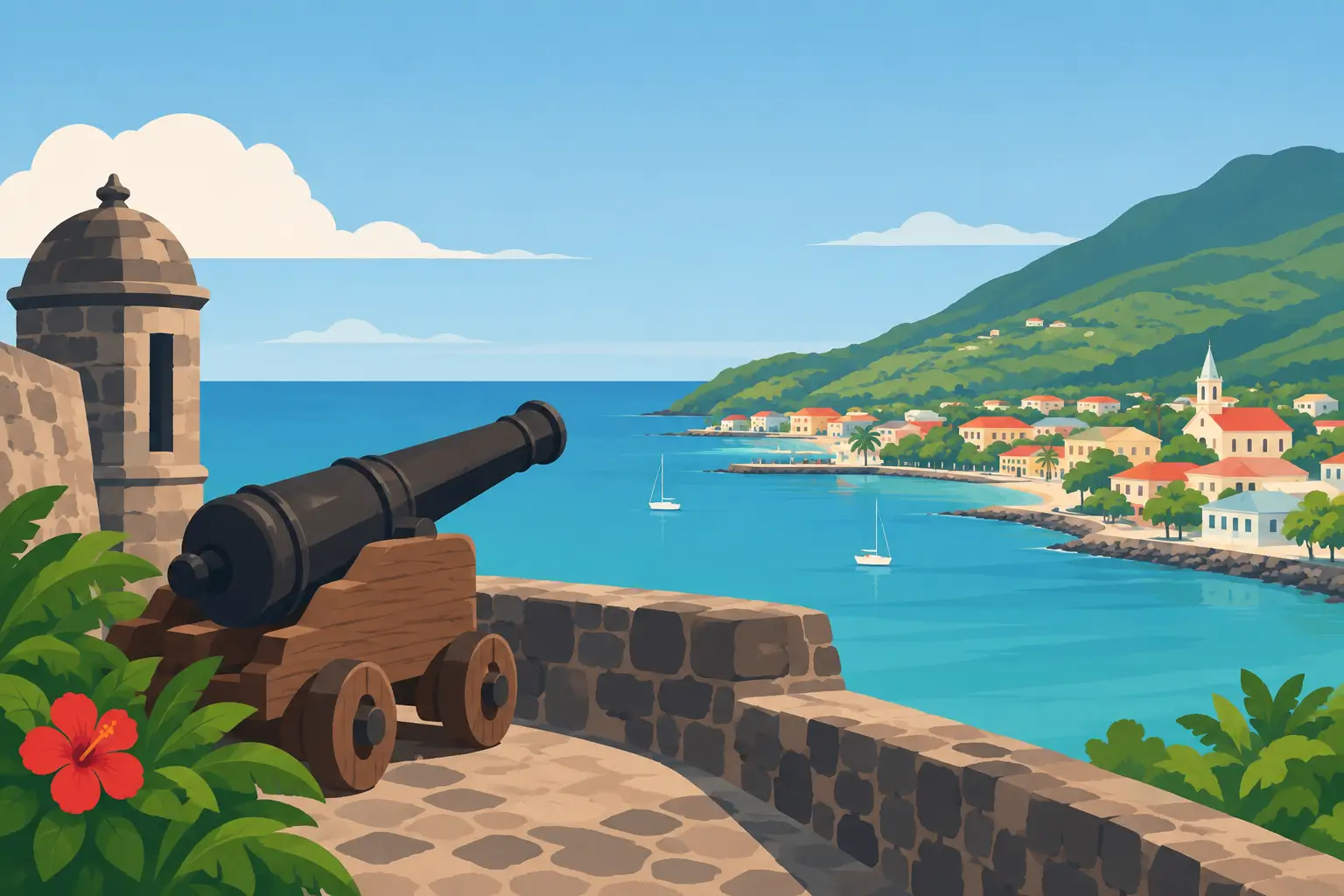
The cobbled streets of Lower Town do not need much imagination. Stone warehouses still face the sea, Fort Oranje still watches from the bluff, and a steep path still connects the harbor to the town above. This Statia colonial history guide helps you read those remains for what they are: evidence of an island that was once central to Atlantic trade, international conflict, and the lives of free and enslaved people.
St. Eustatius, known locally as Statia, is small enough to explore at an unhurried pace. Its colonial story, however, reaches far beyond its shoreline. A visit here is less about checking monuments off a list than noticing how geography, commerce, faith, and power shaped a place that has never been merely a footnote in Caribbean history.
The Statia Colonial History Guide: Start With the Landscape
Oranjestad is built in two distinct levels, and that layout explains much of its past. Upper Town sits along the ridge, where officials, merchants, churches, and defensive works looked over the bay. Lower Town lies at the water’s edge, where ships anchored and goods moved through warehouses, shops, and homes.
The climb between them is physical, especially in Caribbean heat, but it is also revealing. Colonial Statia was organized around the harbor. Ships arrived carrying people, provisions, manufactured goods, and, tragically, enslaved Africans. They left with goods that connected this small Dutch Caribbean island to Europe, North America, and neighboring colonies.
The island changed hands repeatedly among European powers during the 17th and 18th centuries. Dutch control, established in 1636, endured longest, but English and French occupations reflected the larger contests playing out across the Caribbean. Statia was valuable not because it had vast plantations or a protected natural harbor, but because its location made it an unusually useful trading point.
Golden Rock and a Free Port Economy
In 1756, Statia became a free port. The decision transformed the island. Merchants of different nationalities could trade here with fewer restrictions than elsewhere in the region, and the bay below Oranjestad filled with vessels. At the height of this commercial era, the island earned the nickname Golden Rock.
That prosperity was real, but it should not be romanticized. Trade brought wealth to some merchants and residents, while the economy depended deeply on slavery and the Atlantic trafficking of human beings. Enslaved people labored in homes, businesses, construction, and agriculture, sustaining the systems that made Statia profitable. The surviving warehouses may be picturesque, but they are also part of that history.
The First Salute
Statia’s most famous moment came on November 16, 1776. From Fort Oranje, Governor Johannes de Graaff returned a salute from the American brig Andrew Doria, which was flying the flag of the newly declared United States. The gesture is widely remembered as the first international recognition of American independence.
For American visitors, it is an arresting connection: a quiet Caribbean fort linked to the birth of the United States. Yet the salute was not simply a ceremonial act of friendship. It also reflected the commercial realities of the day. Statia supplied the American revolutionaries with goods they struggled to obtain elsewhere, and that trade angered Britain.
War Changed the Island’s Fortunes
Britain captured Statia in 1781 during the Fourth Anglo-Dutch War. Admiral George Rodney seized a vast volume of goods in the harbor and targeted the island’s mercantile community, including its Jewish residents, whose trading networks had helped make the free port thrive. Dutch rule later returned, but the island never fully recovered its former commercial position.
Changing trade routes, larger ports, warfare, and shifting imperial priorities diminished Statia’s importance. The 19th century brought further hardship. Slavery was abolished in the Dutch Caribbean in 1863, a necessary legal change that did not erase the inequalities created over generations. The island’s population and economy continued to contract, leaving much of its built heritage exposed to weather, time, and the elements.
Colonial Sites Worth Seeing in Oranjestad
A thoughtful walking route can bring this history into focus. Begin at Fort Oranje, where yellow walls, cannons, and wide sea views make the island’s strategic role immediately clear. The fort is a place to pause rather than rush through. From here, the harbor below shows why control of this bluff mattered.
Nearby, the Dutch Reformed Church ruins are among the island’s most recognizable landmarks. Their roofless stone shell is beautiful, but the site also speaks to a settlement shaped by religious communities, hurricanes, changing populations, and long decline after the trade boom.
The Honen Dalim Synagogue ruins, dating to the 18th century, offer another essential perspective. Statia’s Jewish community was small but influential in the island’s commercial life. The synagogue’s remains are a reminder that colonial Caribbean society was more diverse than the simplified stories of competing European flags often suggest.
Then make your way down toward Lower Town. The warehouse ruins along the bay are best seen slowly, preferably in the cooler part of the day. Their scale is the surprise. What now feels like a peaceful waterfront once operated as a busy international marketplace, with ships anchored offshore and small boats carrying cargo back and forth.
The historic path between Upper and Lower Town is uneven, steep, and not ideal for everyone. Sturdy shoes, water, and sun protection are sensible. Travelers with limited mobility may prefer to view both levels by vehicle and spend more time at the fort and waterfront rather than attempting the descent.
How to Read the Ruins With Care
Statia’s heritage sites are compelling partly because they are not heavily staged. You will not find a resort-style historical district with every story polished into a simple narrative. That is a rare reward for travelers who would rather discover than arrive, but it asks something of the visitor as well.
Look beyond the military story. Ask who built the walls, loaded the cargo, prepared the homes, and lived with the consequences of colonial rule. Consider why some buildings were preserved while others disappeared. The island’s past includes enterprise and exchange, but also dispossession, forced labor, religious discrimination, and the unequal distribution of wealth.
Local context matters. A museum visit, a conversation with a knowledgeable local guide, or time spent reading site interpretation can add depth to the ruins. This is especially worthwhile if you have only a short stay. Statia is compact, but its history is not.
Plan a History-Focused Day on Statia
Give the historic core at least half a day, and longer if you enjoy photography, architecture, or archival detail. Start early at Fort Oranje, continue through Upper Town’s church and synagogue ruins, then descend to Lower Town before the afternoon heat peaks. Pair the walk with lunch in Oranjestad and leave room for a slower look at the bay from above.
Opening times, access conditions, and guided offerings can change on a small island, particularly around weather and local events. Confirm current arrangements directly before building a tight itinerary. If you are combining heritage with diving or hiking, avoid packing every activity into one day. The island, as it feels, is best understood with a little space between plans.
At sunset, stand near the fort and look down over the water. The ships are gone, the harbor is quiet, and that contrast is the point. Statia’s colonial history is not preserved as spectacle. It remains in the contours of the town, the broken stone, and the questions a small island can still ask of the wider world.
