
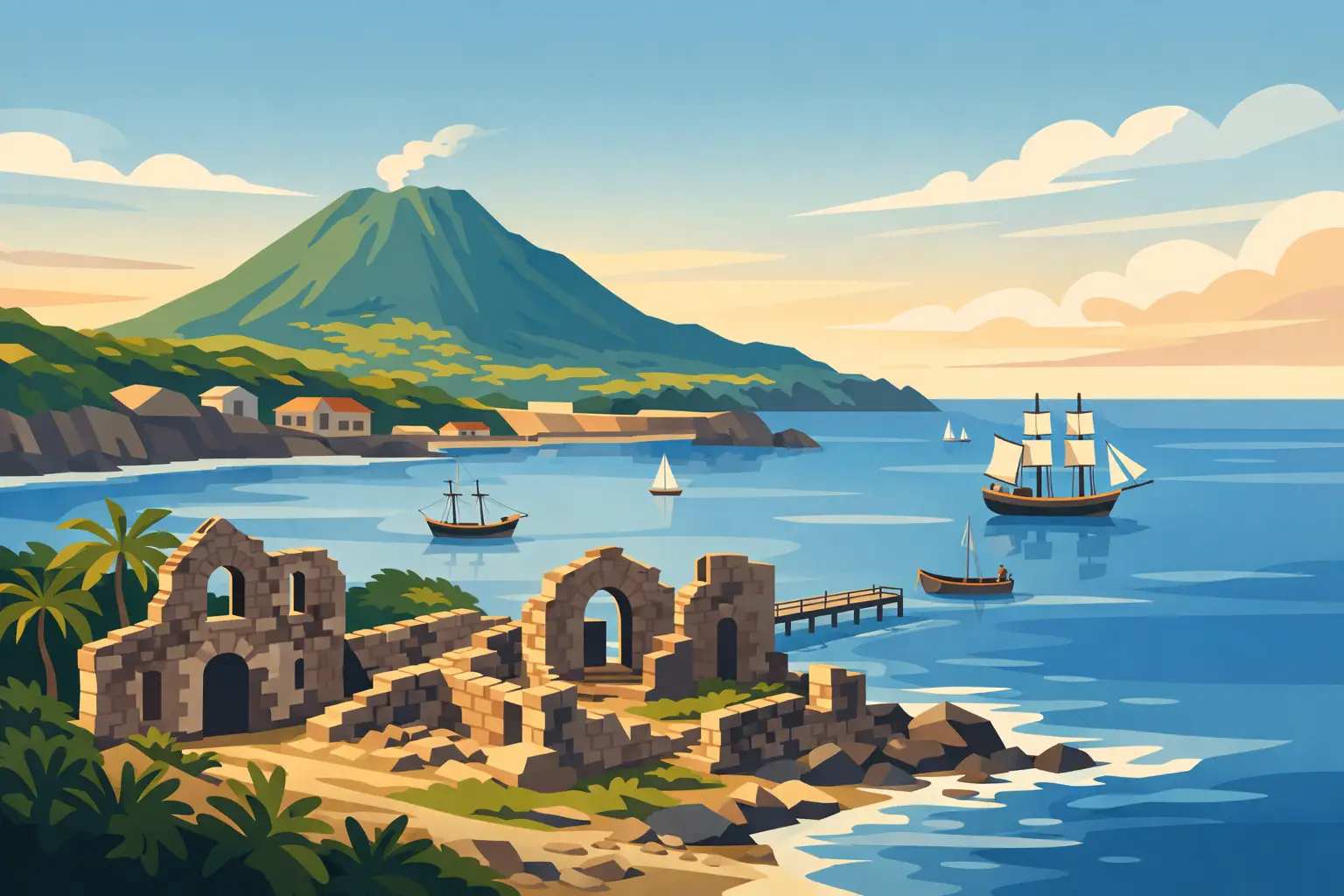
The Lower Town ruins Statia are not arranged like a formal museum district. They sit along the waterfront below Oranjestad, where volcanic slopes meet the Caribbean and old stone walls still face the bay. Walk here slowly and the island’s famous past becomes less abstract: this was once a working shore of warehouses, merchants, sailors, enslaved people, cargo, noise, and extraordinary international ambition.
For travelers who would rather discover than arrive, Lower Town offers one of St. Eustatius’ most revealing walks. It is a place for looking closely - at carved stone, arched openings, weathered foundations, and the sea that made this small island a major name in Atlantic trade.
Why the Lower Town ruins matter
In the late 18th century, St. Eustatius was one of the Caribbean’s most active free ports. Ships came through the roadstead below Oranjestad to trade goods that moved between European colonies, North America, and the wider Atlantic world. Its neutral trading status made the island particularly valuable during periods of political conflict, including the American Revolutionary War.
That prosperity was concentrated along the shore. Lower Town held warehouses and commercial buildings where goods were stored, sold, and prepared for onward shipment. Sugar, tobacco, rum, textiles, weapons, and supplies passed through the island, alongside the immense human cost embedded in the colonial economy and transatlantic slavery. The ruins are beautiful in a quiet, elemental way, but they are not merely picturesque remnants. They belong to a complex history of wealth, power, exploitation, and survival.
The shoreline later changed through warfare, economic decline, storms, and time. What remains is fragmentary, which is part of the experience. Rather than a recreated streetscape, you encounter the outlines of a port city that once mattered far beyond its size.
Walking Lower Town in Oranjestad
The best approach is unhurried. From Upper Town, the road descends toward the bay, opening broad views across the water. As you reach Lower Town, the scale shifts. Stone walls and foundations appear close to the road, often set against dry grass, sea grape, and the bright, shifting blue of the Caribbean.
The waterfront route is manageable for most independent visitors, though heat is often the deciding factor. Go earlier in the morning or later in the afternoon, bring water, and wear shoes suitable for uneven surfaces. There is little shade in places, and the island’s sun can make even a short heritage walk feel longer than expected.
Do not expect every structure to have extensive interpretation on site. This is one reason a local guide can add real value, especially for travelers interested in the stories behind the stones. A guide can help distinguish a warehouse wall from a domestic building, place the harbor in its historical context, and connect Lower Town to the fortifications and civic landmarks above.
Read the harbor before the ruins
Pause often to look out to sea. The anchorage itself was the engine of Lower Town. Before modern piers and container terminals, ships anchored offshore and goods moved between vessels and shore by smaller boats. The exposed bay could be difficult, particularly in rough conditions, yet its position on major sea routes made Statia a remarkably useful place to trade.
This perspective changes the walk. The walls are not isolated ruins. They are the landward edge of a former commercial system built around wind, sail, labor, risk, and the constant arrival and departure of ships.
Notice what is still standing
Look for the thickness of the masonry, the shape of doorways, and the practical placement of buildings near the water. Warehouses were designed for storage and movement, not for ornament, but the surviving architecture has a strong presence. Coral stone, volcanic materials, and lime mortar tell their own story of local resources and Caribbean building traditions.
Some buildings and sites have been stabilized or restored over time, while others remain deliberately legible as ruins. That difference is worth respecting. Restoration can make history easier to see; weathered remains can make the passage of time more palpable. Lower Town has room for both.
Pair the ruins with the island’s bigger story
A Lower Town visit becomes richer when it is part of a wider day in historic Oranjestad. Start or finish near Fort Oranje, high above the bay, where cannons and ramparts offer a commanding view of the harbor below. From there, the relationship between Upper Town’s government and merchant life and Lower Town’s waterfront commerce becomes immediately clear.
The Dutch Reformed Church Historic Cemetery is another thoughtful stop for those interested in the people behind the island’s colonial era. Names, dates, and family connections offer a more personal counterpoint to the grand narrative of trade. History here is not confined to one viewpoint, and the most worthwhile visit is one that makes room for that complexity.
If you have more time, continue toward the island’s other heritage landscapes, including plantation-era sites and the remains of defensive structures. Statia is small enough that its stories overlap. A harbor warehouse, a hilltop fort, a cemetery, and a hiking trail may all sit within a short drive of one another, yet each reveals a different layer of the island as it feels.
Practical advice for a respectful visit
Lower Town is best treated as a heritage landscape rather than an attraction to rush through. Stay on obvious paths and public areas, do not climb fragile walls, and avoid removing stones or other materials. The ruins have endured centuries of weather, and their future depends on careful visitors as much as formal preservation.
Photography is welcome for many travelers, particularly in the soft light near sunset, but keep private property and residents in mind. Lower Town is close to an active community, not a sealed-off historical set. If you are unsure whether an area is accessible, ask locally before entering.
There are also a few planning realities that reward flexibility. Services on St. Eustatius are personal and small-scale, and guide availability can be limited. If a guided heritage walk matters to your trip, arrange it ahead of time and confirm the meeting point and timing directly. Rain showers, heat, and changing transport schedules can shape a day’s plans, so leave room to adjust.
For independent travelers, pairing the ruins with lunch in Oranjestad creates an easy half-day. For history enthusiasts, divers, and hikers, it works well as a quieter counterbalance to a morning underwater or on the slopes of The Quill. The island does not demand a packed itinerary. It rewards attention.
A ruin with a living horizon
There is a particular moment in Lower Town when the past and present seem to share the same frame: a rough stone wall in the foreground, the open roadstead beyond it, and perhaps a fishing boat moving across the bay. It is easy to understand why Statia’s history feels unusually close here.
Come with curiosity rather than a checklist. Read a few details, listen for the stories that complicate the postcard view, and then look back out over the water. The harbor is still the best guide to what these ruins mean.