
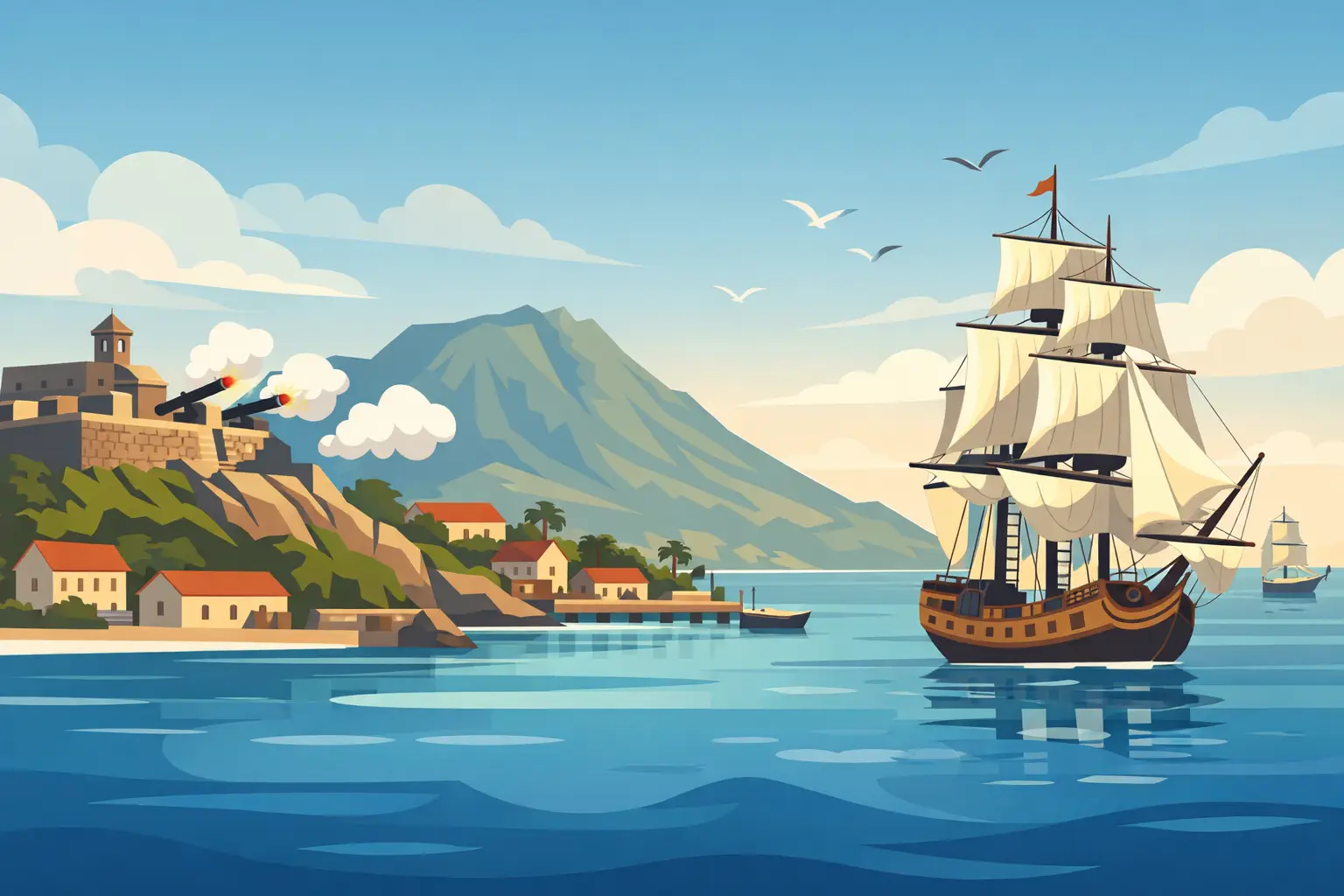
On November 16, 1776, a cannon salute from Fort Oranje carried farther than the harbor below. The first salute returned to the American brig Andrew Doria was a brief exchange of maritime courtesy, but its meaning was immense: St. Eustatius had acknowledged the flag of the newly declared United States. For a small Caribbean island, it was a moment of uncommon consequence - and one that still gives a walk through Oranjestad’s historic center a particular charge.
This is not history kept behind glass. Fort Oranje still looks over the bay. The lower town still follows the waterfront that once brimmed with warehouses, ships, traders, and rumor. Stand at the fort’s edge and the story feels less like a distant footnote and more like what it was: a daring gesture made in a strategic harbor at a volatile moment.
What was the first salute?
The American Revolution was underway, but in late 1776 the United States was not yet widely recognized as an independent nation. The Andrew Doria, sailing under the Continental colors, arrived at St. Eustatius carrying a message for Governor Johannes de Graaff.
The ship fired a salute. De Graaff ordered Fort Oranje to return it, reportedly with eleven guns to the vessel’s thirteen. Under the conventions of the day, the response was understood as recognition of the flag. The Netherlands did not formally recognize American independence until later, and the episode remains nuanced in diplomatic terms. Yet the exchange became celebrated in the United States as the first official salute to the American flag from a foreign power.
That distinction matters. Statia did not single-handedly determine the outcome of the Revolution, nor was the act a simple declaration of alliance. But it was an early public signal of respect for a country still fighting to prove it could endure. In the language of cannons and flags, it was heard.
Why St. Eustatius was the island that mattered
In the eighteenth century, St. Eustatius was one of the Caribbean’s great trading crossroads. Its Dutch free-port status drew merchants from across the Atlantic world. Goods moved through the island in extraordinary volume: sugar, coffee, tobacco, textiles, weapons, ammunition, enslaved people, and information. The waterfront below Fort Oranje was lined with warehouses and crowded with vessels from competing empires.
Its power came from position rather than size. Statia sat where trade routes, colonial rivalries, and private ambitions converged. Dutch neutrality made the island useful to those who wanted to buy or sell beyond the restrictions imposed by their own governments. For the American revolutionary cause, that access was significant. Supplies acquired through Caribbean trade helped sustain the colonies’ struggle against Britain.
This prosperity gave the island its enduring nickname, the Golden Rock. It also made Statia vulnerable. The same commercial importance that enriched it drew the attention of larger powers, and the island changed hands repeatedly through the colonial era. British forces captured St. Eustatius in 1781, partly because of its support for American trade, though the island was later restored to Dutch control.
The first salute belongs to that larger, complicated story. It was not an isolated act of symbolism. It emerged from a harbor where commerce, politics, and survival were closely intertwined.
Fort Oranje: where the moment is felt
Fort Oranje is the natural place to begin. Built above Oranjestad Bay, the fort was designed to defend the anchorage and project authority over the island’s commercial heart. Its stone walls, cannons, and broad views give shape to a past that can otherwise feel abstract.
Visitors will find the fort above Lower Town, within easy reach of the waterfront and many of the island’s historic sites. The setting is remarkably open. There are no turnstiles separating the view from the sea, no staged spectacle required. You can look down to the bay, trace the coastline, and imagine the Andrew Doria at anchor below.
The fort is also home to the St. Eustatius Historical Foundation Museum, housed in a former Dutch Reformed church. Its displays add context to the island’s Indigenous, African, European, Jewish, maritime, and colonial histories. Allow time for both the museum and the grounds. The cannon salute makes more sense when seen alongside the wider human story of the island - including the people whose labor created the wealth that passed through this port.
Look beyond the cannons
It is tempting to treat Fort Oranje as a single-photo stop. Give it longer than that. Notice how close the harbor sits to the town, how the steep slope separates Lower Town from the homes and civic buildings above, and how easily a fort could watch every vessel arriving offshore.
Then walk down into Lower Town. The surviving foundations and waterfront ruins speak to the scale of the trade that once took place here. Salt air, heat, and time have softened the scene, but the geography remains eloquent. This was a working port, not a ceremonial backdrop.
A history worth holding with care
The first salute is often told as a triumphant American story, and it is rightly meaningful to many US visitors. But on St. Eustatius, it is part of a broader island history that resists easy celebration.
The Golden Rock’s commercial success depended in part on slavery and colonial exploitation. Enslaved Africans were bought, sold, and forced to labor on the island and across the region. Wealth moved through Statia’s harbor, but it was not shared equally, and the colonial trade networks that made the island influential caused deep and lasting harm.
A thoughtful visit makes room for both truths. The returned salute represented a bold act in the story of American independence. It also took place within an Atlantic system shaped by empire, coercion, and unequal power. The island’s historical sites are most rewarding when approached with curiosity rather than a search for uncomplicated heroes.
That perspective is part of what makes Statia different. Here, history is not polished into a resort amenity. It is visible in forts, churches, warehouses, roads, cemeteries, and the lived knowledge of a close-knit island community.
Planning a meaningful visit to the first salute site
Fort Oranje is easy to include in a relaxed day in Oranjestad. Visit in the morning or later afternoon, when the light is gentler and the harbor view is especially clear. Wear shoes suitable for uneven stone and sloping streets, bring water, and expect the pace to be quieter than at a major Caribbean cruise port. That quiet is part of the rare reward.
Pair the fort with time in Lower Town, then linger over lunch in town rather than rushing onward. Travelers interested in heritage can also seek out the island’s historic churches, Jewish cemetery, and plantation-era landscapes. Each site adds another layer to the story of an island that was once far more central to Atlantic affairs than its size suggests.
If your stay is short, confirm museum opening times and local transport arrangements directly before you go. Schedules can change, and Statia’s limited scale means a little advance planning goes a long way. Independent travelers may enjoy exploring on foot around Oranjestad, while those venturing farther afield will want to arrange a vehicle, taxi, or local guide.
For Americans, the first salute can be a surprisingly personal reason to come. For everyone else, it is an invitation to reconsider how history happens. Not always in capitals, and not always through grand declarations, but sometimes from a small harbor beneath a Caribbean fort.
When you stand at Fort Oranje, take a moment before reaching for the camera. Watch the water, the anchored boats, and the horizon beyond the bay. The cannon smoke is long gone, but the island still offers the same gift it did in 1776: a small place with a remarkably large view of the world.