
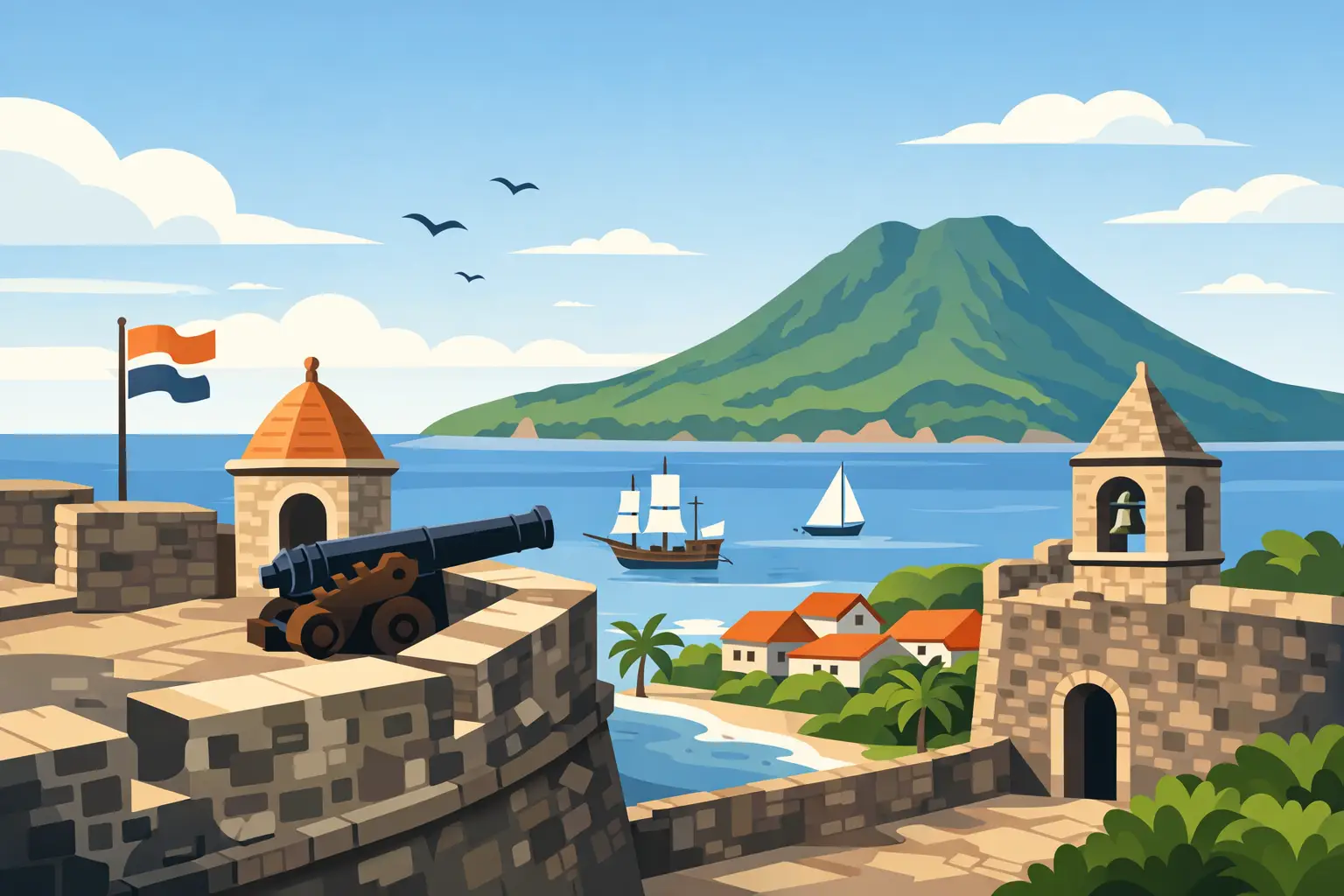
The first thing you notice at Fort Oranje Statia is not the cannon. It is the view: the deep-blue sweep of Oranje Bay, the shoreline below, and the sense that this small island once stood at the center of a much larger world. From its bluff above Oranjestad, the fort makes St. Eustatius feel both intimate and consequential - a rare combination in the Caribbean.
This is not a polished, theme-park version of history. Fort Oranje carries the marks of changing empires, international commerce, war, and the lives of people whose labor made Statia prosperous. Come for the panorama, certainly. Stay long enough to understand why this quiet place matters.
Why Fort Oranje Statia Matters
Built by the Dutch in 1636, Fort Oranje was positioned to protect the island's anchorage and the commercial settlement that grew around it. Its location was strategic. Ships traveling between North America, Europe, and the Caribbean could call at Statia, replenish supplies, exchange cargo, and move on. At the height of its trading era in the 18th century, the island's harbor was crowded with vessels and its warehouses held goods from across the Atlantic world.
Statia became known as a free port, where merchants traded with fewer restrictions than they found on neighboring islands. That openness brought extraordinary wealth and influence to a place only a few square miles in size. It also tied the island to systems of colonial extraction and enslavement. The prosperity visible in the harbor, warehouses, and merchant homes was inseparable from the forced labor of enslaved Africans and the brutal economy of the Atlantic slave trade.
Fort Oranje is therefore best experienced as more than a scenic stop. Its walls overlook a landscape shaped by ambition, exchange, conflict, and survival. The view is beautiful, but it is not uncomplicated.
The First Salute
Fort Oranje is most widely known for an event that connected Statia to the American Revolution. On November 16, 1776, Governor Johannes de Graaff ordered a return salute to the American brig Andrew Doria after it entered Oranje Bay flying the new American flag. The exchange is often called the First Salute, and it was a powerful public acknowledgment of the emerging United States at a moment when its independence was far from assured.
The gesture was politically charged. Trade between Statia and the American colonies had already irritated Britain, which viewed the island as a valuable source of supplies for its opponents. The salute deepened that tension and became part of the wider contest for control of the Caribbean. For visitors from the United States, standing at the fort offers an unusually tangible connection to the early republic - not in a grand capital city, but on a small Dutch Caribbean island.
It is worth holding the story with care. The salute was a symbolic naval courtesy, not a simple modern-style diplomatic recognition, and the period around it was shaped by competing colonial powers. That complexity is part of what makes the site compelling.
What You Will See at Fort Oranje
The fort sits at the edge of Upper Town, close enough to Oranjestad's central streets to visit without needing a full day. Its stone ramparts and open grounds are modest in scale, especially for travelers familiar with sprawling European fortifications. Yet the setting gives every remaining feature weight.
Look out over the bay first. Below, the remains of Lower Town trace the island's former commercial shoreline, where merchants, sailors, laborers, and visitors once moved between ships and warehouses. The water is often calm and bright, but this was once one of the busiest trading scenes in the region.
Within the fort, cannon face the sea and the walls frame views toward the harbor. The grounds also reveal how a defensive post could serve as a seat of colonial authority. Details may be restrained, and interpretation can vary, so a local guide or a conversation with a museum professional can add valuable context beyond what the stones alone can tell you.
Do not rush through in five minutes for a photo. Walk the perimeter slowly, notice the elevation, and imagine the practical reason for every sightline. The fort was designed to watch the bay, control access, and signal power. It now offers a quieter kind of perspective.
The Best Time to Visit
Early morning and late afternoon are the most comfortable times to visit Fort Oranje. The light is softer, the stone is less punishing underfoot, and Oranje Bay often looks especially clear from above. Late afternoon also suits photographers, although the exact conditions depend on cloud cover and the season.
A midday visit can still work if you are exploring Upper Town, but bring water, sun protection, and a hat. Shade on the open fort grounds is limited. Brief rain showers can pass through at any time of year, leaving surfaces slick, so shoes with good grip are a better choice than beach sandals.
The site is easy to reach from central Oranjestad, but the terrain is not uniformly smooth. Travelers with limited mobility should expect uneven surfaces and ask locally about the most manageable approach. As with many heritage sites on a small island, access arrangements and opening times can change. Confirm current details locally before building your day around a visit.
Make a Half-Day of the Fort and Oranjestad
Fort Oranje works best as the anchor of a heritage-focused morning or afternoon rather than a standalone expedition. Start in Upper Town, where the streets retain the quiet scale of a place that has never been remade for mass tourism. Then descend toward Lower Town, taking in the contrast between the fort's elevated authority and the waterfront's commercial past.
The St. Eustatius Historical Foundation Museum can add useful depth to what you see outside, especially if you are interested in the island's colonial period, archaeology, or daily life across different eras. The ruins and surviving structures in Lower Town make the history feel physical: stone foundations, old warehouse walls, and the outline of a harbor economy that once reached far beyond the island.
Afterward, pause for lunch in Oranjestad rather than treating the visit as a box to check. Statia's pace is part of the experience. A meal, a cold drink, and a conversation with someone who knows the island can turn a historical stop into a more personal encounter with place.
If you have more time, pair the fort with a hike on The Quill or a day in the marine park. The combination explains Statia particularly well: an island whose volcanic contours offered natural protection, whose harbor drew the world in, and whose surrounding waters remain central to its identity.
Visit With Respect for the Story
Fort Oranje has survived because it is both a landmark and a working reminder of the island's past. Stay on established paths, avoid climbing on masonry or cannon, and leave stones and artifacts where they belong. The fort is not a backdrop detached from its history; it is part of a protected cultural landscape.
Bring curiosity, too. Ask about the people absent from old official accounts: enslaved families, free Black residents, laborers, traders, soldiers, and island communities whose experiences made the 18th-century port function. The strongest visit is not one that turns Statia into a footnote to another nation's history. It is one that recognizes the island on its own terms.
From Fort Oranje, the horizon still appears open in every direction. Take a few unhurried minutes before you leave. On St. Eustatius, a view can be beautiful, but it can also ask you to look more closely.
