
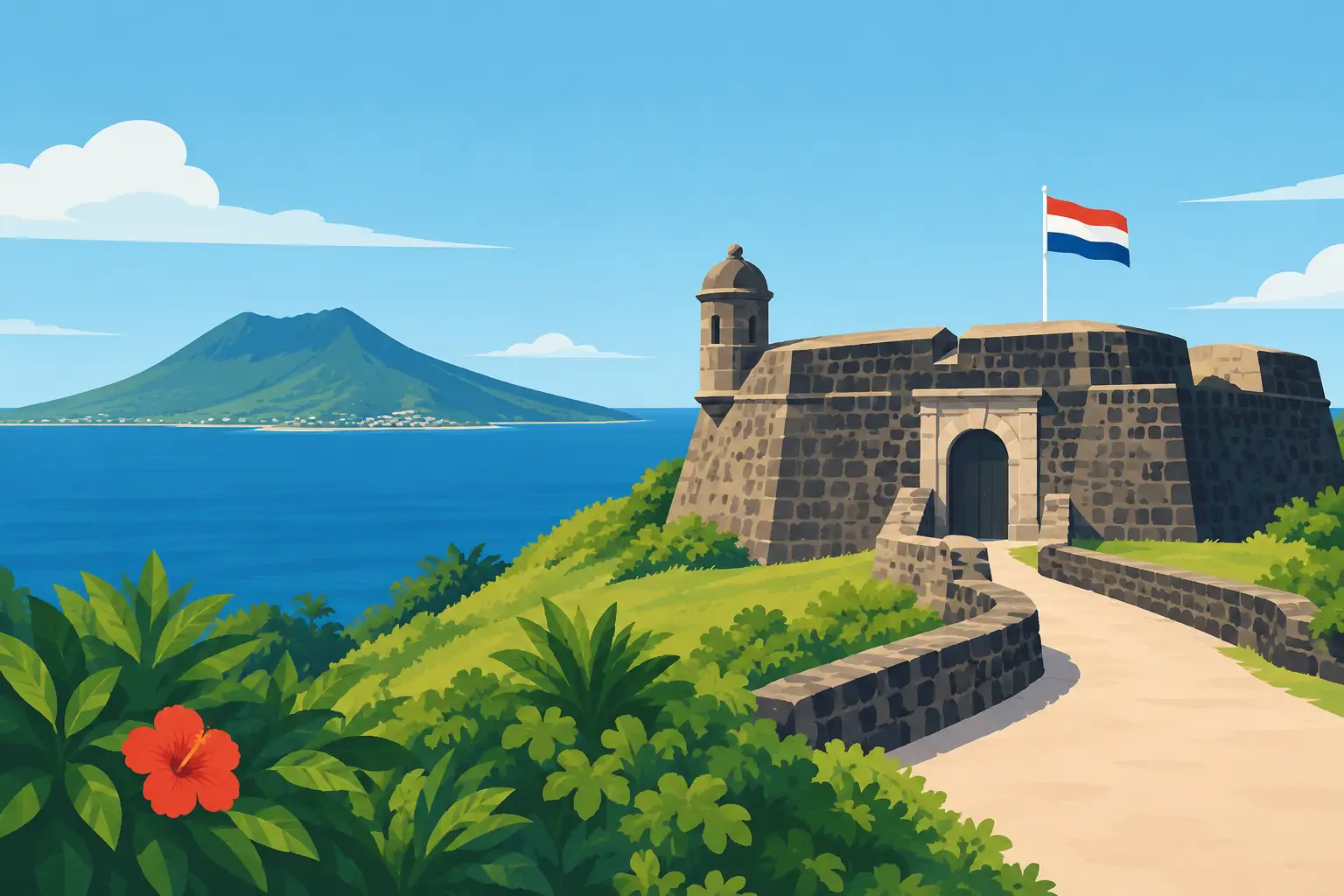
Fort Oranje does not ask for much time, but it rewards attention. If you are wondering how to visit Fort Oranje, think of it less as a stand-alone attraction and more as the high point of a walk through Oranjestad's remarkable past. From its walls, the lower town, the Caribbean Sea, and the island's historic waterfront unfold below you - a view that makes the scale of St. Eustatius's former global importance feel suddenly real.
Built in 1636, the fort has watched Dutch, English, French, and American ships come and go. Its cannons still face the sea, but the experience is not staged or overproduced. This is heritage on a small, lived-in island: weathered stone, wide horizons, and a setting that invites you to slow down.
How to Visit Fort Oranje
Fort Oranje sits on the edge of Upper Town in Oranjestad, above the historic Lower Town. For most visitors, it is easy to reach by car, taxi, or on foot from accommodations and restaurants in the town area. The final approach is short, though the island's hills and heat can make even a brief walk feel more demanding around midday.
If you are walking from the waterfront or Lower Town, allow time for the climb. The route uphill is part of the experience, passing through the layered streets that once linked warehouses, merchants, churches, homes, and the harbor. Wear shoes with grip rather than beach sandals, especially if you plan to continue toward other historic sites or walk back down to the bay.
The fort grounds are generally best approached during daylight hours. Access conditions, maintenance work, and the opening arrangements for nearby public buildings can change, so confirm locally if you have your heart set on visiting at a particular time. On an island with an unhurried rhythm and limited staffing, flexibility is not a compromise - it is part of traveling well.
There is no need to rush your visit. Give yourself 30 to 45 minutes for the fort itself, longer if you enjoy photography, history, or simply sitting with the view. Pair it with a walk through Upper Town and Lower Town, and it becomes a memorable half-day rather than a quick photo stop.
Choose Your Time for Light, Shade, and Quiet
Early morning is the most comfortable time to visit Fort Oranje. The sun is softer, the air is cooler, and the sea beyond the cannons often appears especially clear. It is also a fine time for photographs of the fort's warm stonework before the Caribbean light becomes stark.
Late afternoon offers another kind of appeal. The town settles, shadows deepen across the walls, and the view west over the water takes on a quieter character. If you visit then, leave enough time to return to your accommodation before dark. Roads and sidewalks on St. Eustatius are not always designed for evening strolls, particularly away from the center of town.
Midday works if it is the only window in your itinerary, but bring water and use sun protection. There is limited shade on the exposed fort grounds, and the reflective stone can make the heat feel more intense. A hat and a light cover-up are more useful here than a tightly scheduled plan.
What You Will See at the Fort
The defining feature is the sea view. Look down toward Lower Town and the shoreline, where ships once anchored offshore and goods moved between the beach and the warehouses above. In the 18th century, St. Eustatius was known as the Golden Rock, a busy free port whose commercial reach far exceeded its size. Standing at Fort Oranje makes that history easier to imagine than any date on a plaque could.
Take time to notice the cannon line and the fort's defensive position. This was not a remote ruin built for atmosphere. It occupied a strategic perch over a harbor that drew competing colonial powers and traders from across the Atlantic world.
The fort is also closely connected to one of the most significant moments in American history. In 1776, the island became the first foreign territory to formally salute the newly independent United States when Governor Johannes de Graaff returned a salute from the American brig Andrew Doria. The event is commemorated at the fort and gives this small Caribbean site an outsized place in the story of the American Revolution.
That history deserves a little context. The island's prosperity was built within colonial trading systems that included the enslavement and exploitation of people. Visiting thoughtfully means seeing both the beauty of the setting and the difficult human history embedded in the town, its forts, warehouses, and burial grounds.
Make Fort Oranje Part of a Heritage Walk
Fort Oranje is most meaningful when you connect it to the landscape around it. Start in Upper Town, where churches, public buildings, and historic streets speak to the island's administrative and social life. From there, look down toward Lower Town, once the commercial engine of Statia.
When the weather is manageable, continue downhill to explore the remains of stone warehouses and old merchant buildings near the shore. The contrast is striking: Fort Oranje looks outward from above, while Lower Town reveals the physical labor and movement that sustained the harbor below. Bring water, move carefully on uneven surfaces, and avoid assuming every historic structure is open for entry.
If you are traveling with a guide, ask for a route that includes the fort and the Lower Town ruins. A local guide can offer the kind of detail that changes what you are seeing - which buildings served trade, where people lived, how the harbor worked, and how the island's communities shaped its history. Independent visitors can still have a rich experience, but a guided walk is especially worthwhile for travelers drawn to the deeper story rather than only the view.
Practical Details Before You Go
Fort Oranje is a straightforward stop, but a little preparation helps. St. Eustatius is compact, yet its services and schedules are shaped by island scale. Taxis, rental vehicles, restaurant hours, and excursions may require advance coordination, especially outside the busiest travel periods.
Bring four simple things: water, sun protection, comfortable walking shoes, and a phone or camera with enough battery for photos. A small umbrella or rain layer can also be useful during passing showers, though you may prefer to wait them out before walking over exposed ground.
There are a few courtesy points worth keeping in mind. The fort is a historic site rather than a playground, so do not climb on walls or cannons. Keep clear of any areas marked for preservation or repair. And because the fort is near civic buildings and a residential town, keep noise low and dress as you would for a village walk, not only for the beach.
Visitors with limited mobility may find the fort's location easier to manage by car or taxi than on foot. The views can be enjoyed with minimal walking once you arrive, but surfaces may be uneven and conditions can vary. If accessibility is central to your plans, ask locally about the most suitable drop-off point before setting out.
A Small Stop With a Long View
Fort Oranje is not a place to race through between breakfast and the beach. Come when you have room in the day to pause at the wall, trace the coastline below, and consider how this quiet island once stood at the center of currents that reached far beyond the Caribbean.
Then let the visit lead somewhere else: down into Lower Town, into a local lunch, or onward to a dive site whose reefs have their own stories of ships and trade. On St. Eustatius, the rare reward is often not one landmark, but the way each place gives the next one more meaning.
