
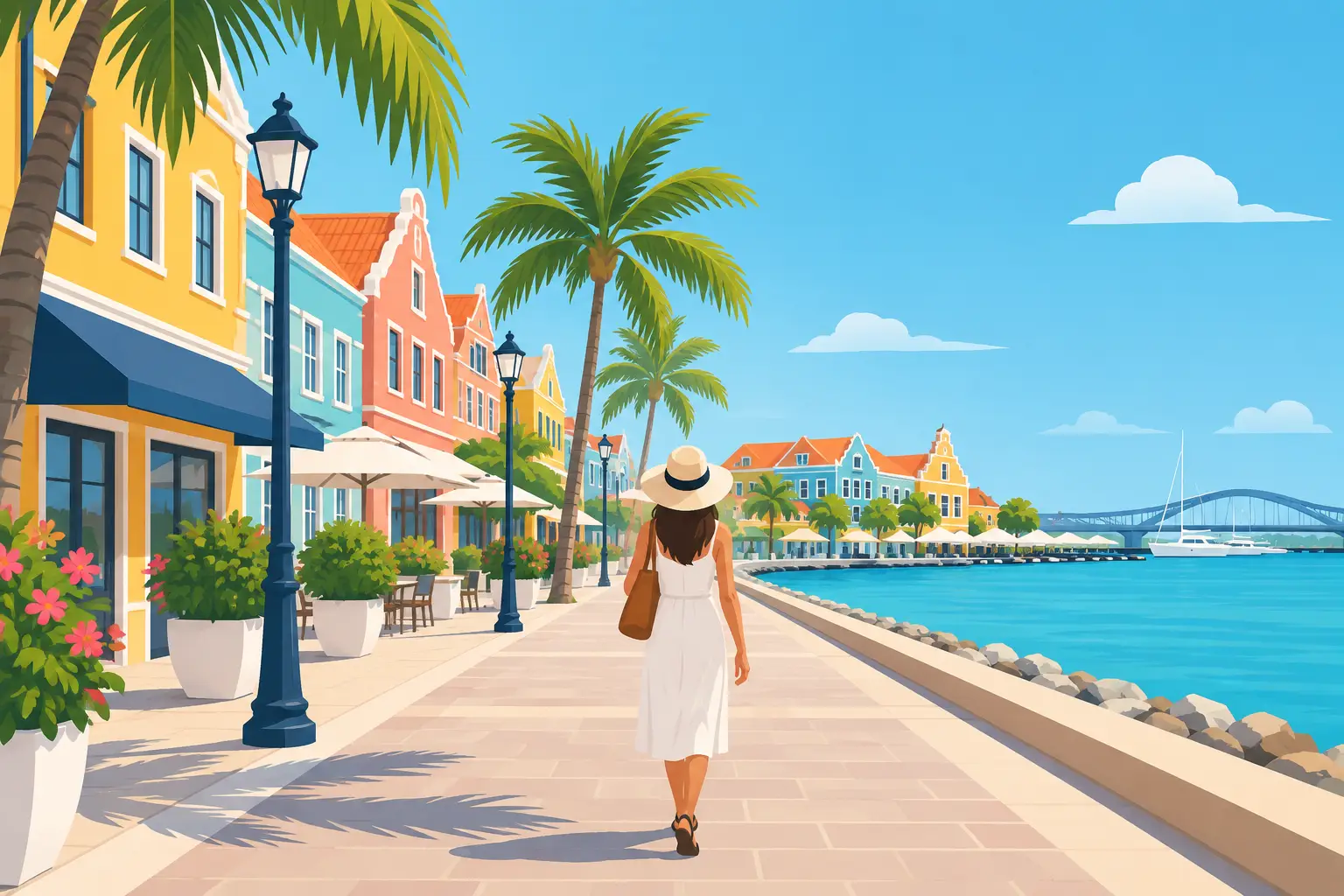
The first thing you notice when you explore Oranjestad on foot is the change in elevation. One moment, the Caribbean is spread below you in bright, open blue; the next, you are walking past old stone walls, flowering gardens, and buildings that hold centuries of island life. This is not a capital built for rushing. Its rewards reveal themselves between stops - in a weathered doorway, a conversation from a porch, or the view that opens at the end of a quiet road.
Oranjestad is compact enough to walk with intention, yet layered enough to deserve time. The town is divided between Upper Town, set along the slopes of The Quill, and Lower Town near Oranje Bay. Walking connects those two worlds: civic and residential streets above, maritime history and a wide horizon below. For travelers who would rather discover than arrive, it is one of the island's rare rewards.
Start in Upper Town
Begin in Upper Town during the cooler part of the morning. This is where the town feels most lived-in, with government buildings, churches, homes, small businesses, and streets that carry the island's everyday rhythm. There is no need to treat the walk as a checklist. Leave room to look up at gingerbread details, shutters, balconies, and the old masonry that gives Oranjestad its character.
The focal point is Fort Oranje, a compact but commanding fortification above the bay. Its cannons face the sea, a reminder that this small harbor once sat within powerful Atlantic trade routes. The fort is also one of the best places to understand Statia at a glance: the contour of the coast, the deep water beyond it, and the green slope rising behind town.
Take a moment here rather than simply taking a photograph. Oranjestad's history is not presented as a polished set piece. It remains embedded in a functioning town, where historic structures share space with daily errands, school runs, and greetings across the street. That sense of continuity is part of what makes the island feel different from a resort destination.
A town with a big story
St. Eustatius played an outsized role in the 18th-century Caribbean. Its free port drew merchants and ships from across the region, and its harbor became a busy meeting point for goods, information, and competing empires. In 1776, the island became known for returning the first salute to the newly independent United States, an event remembered as an important moment in American-Dutch relations.
You do not need to be a historian to feel the scale of that past. Look down toward the waterfront, where Lower Town once supported warehouses, merchants, and maritime commerce. Then look back at the calm streets around you. The contrast is striking: a place once nicknamed the Golden Rock now moves at a gentler, more human pace.
Walk Down to Lower Town Slowly
The route between Upper and Lower Town is short, but it is steep in places. Treat the descent as part of the experience, not a transition to hurry through. The roads can be uneven, sidewalks are limited, and the tropical sun grows stronger quickly. Closed-toe walking shoes or supportive sandals, water, sun protection, and a hat will make the difference between a pleasant ramble and an uncomfortable one.
As you head toward Oranje Bay, the vegetation changes and the sea becomes more present. Lower Town has a quieter, more elemental atmosphere. Stone ruins and remnants of the old commercial district sit close to the shore, speaking to a period when ships arrived in numbers that are difficult to imagine now.
This is not an area to approach as a recreated historic village. Much of its appeal lies in the fact that the past has not been over-curated. The landscape, salt air, and surviving walls do much of the storytelling. Move respectfully, stay on accessible paths, and remember that historic ruins are fragile. A guided heritage walk can add useful context, especially for travelers who want to understand the buildings and former waterfront activity in greater depth.
Pause by Oranje Bay
Oranje Bay is a natural place to slow down. From here, the view reaches across the Caribbean, and on clear days the neighboring islands seem close enough to touch. The bay is also a working arrival point for dive boats and visiting vessels, so the scene changes with the day.
If swimming is on your mind, check local conditions before entering the water. The shoreline and sea state can vary, and this is not a managed resort beach with constant facilities. For many visitors, the greater pleasure is simply sitting near the water after the walk down, feeling the trade wind and watching the island's maritime life unfold.
Make Room for Local Time
A good walking day in Oranjestad should have pauses built into it. Stop for lunch, coffee, or a cold drink when a local restaurant is open, and do not assume every kitchen or business will follow a large-city schedule. On Statia, limited hours are not a flaw in the experience. They are a practical reality of a small island, where independent places operate around local demand, staffing, and the pace of life.
This is also why advance planning helps. Confirm opening times directly, particularly on weekends, public holidays, or when your visit coincides with a major local event. If you have a restaurant in mind for dinner, reserving ahead is wise. The island's appeal is its intimacy, and capacity is naturally limited.
Walking offers opportunities that a car can flatten. You may notice breadfruit trees in a yard, the sound of goats on a hillside, or a neighbor calling hello as you pass. Respond with the same courtesy. A simple greeting goes a long way, and photographing people or private homes without permission does not.
Practical Notes for Exploring Oranjestad on Foot
Oranjestad is walkable, but it is not uniformly pedestrian-designed. Roads may have narrow shoulders, and drivers should be given space, especially around bends and on the route between Upper and Lower Town. Walk facing traffic where there is no sidewalk, stay alert, and avoid assuming a driver can see you immediately.
The heat shapes the best rhythm. Plan your main walk for early morning or later afternoon, then retreat during the warmest hours for lunch, a rest at your accommodation, or a visit to an indoor heritage site if available. A short route can feel surprisingly demanding in high humidity, particularly if you are carrying beach gear or camera equipment.
Accessibility depends on the exact route. The fort and central streets can be manageable for some visitors, but the slopes, uneven surfaces, and descent to Lower Town may be difficult for travelers with limited mobility. A taxi can make the day more flexible: walk one level of town, ride between elevations, then continue at a pace that suits you. On an island this small, choosing comfort does not mean missing the experience.
Bring cash as a useful backup, though card acceptance varies by business. Keep your phone charged, but do not rely on it as your only source of direction or timing. Service can be variable, and the best moments here are rarely the ones found by searching a screen.
Let the Walk Lead Beyond Town
Oranjestad makes a fitting first encounter with St. Eustatius because it gathers so much of the island's story into a small area: volcanic terrain, Caribbean light, colonial history, and a community that has preserved its own pace. Yet it also hints at what waits beyond town - trails on The Quill, quieter coasts, marine life beneath the surface, and landscapes that feel refreshingly untouched.
Give the walk half a day if you want to move gently, or a full day if you are pairing it with a long lunch and heritage stops. The goal is not to cover every street. It is to let the town set the tempo, then carry that unhurried attention with you into the rest of the island.
