
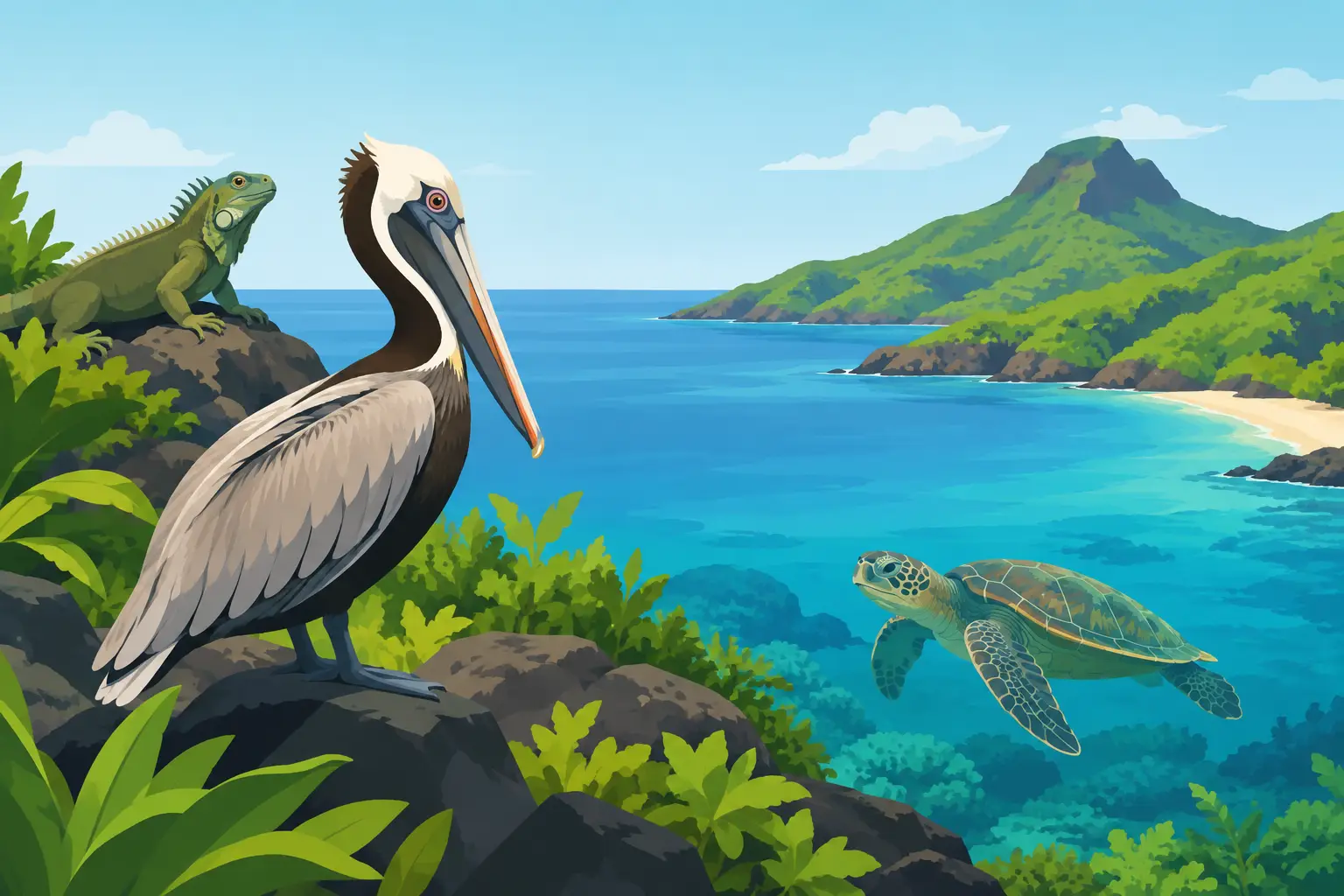
The top Statia wildlife encounters are rarely staged or guaranteed. A sea turtle may appear beside a reef wall on a quiet morning dive; a red-billed tropicbird may cut across the blue above the cliffs; a lizard may pause on a sun-warmed stone before vanishing into the brush. That is part of Statia’s appeal. This is an island where nature remains close, but on its own terms - a rare reward for travelers willing to slow down and pay attention.
Top Statia Wildlife Encounters at Sea
Statia’s most memorable wildlife viewing often begins offshore. The island sits within protected waters, and its underwater world is a principal reason divers return. The marine environment is not an aquarium, and visibility, weather, and seasonal conditions all shape what you will see. Still, the variety packed into a small area can be remarkable.
Sea turtles on reef dives and snorkels
Green and hawksbill turtles are among the island’s most sought-after sightings. Divers may find them feeding over reef slopes, resting beneath ledges, or passing calmly through the blue. Snorkelers can also encounter turtles in suitable nearshore areas, though conditions and access vary, and a guided outing is the more reliable choice for visitors unfamiliar with the coastline.
The best encounter is a patient one. Give turtles room to choose their path, never block their route to the surface, and resist the instinct to follow too closely for a photograph. Touching, feeding, or chasing wildlife changes its behavior and can cause real harm. A few quiet minutes at a respectful distance will feel far more memorable than a rushed close-up.
Statia also supports nesting sea turtles. Nesting activity is seasonal, and sensitive beach locations should not be treated as sightseeing stops. If you are interested in learning about turtle conservation, ask locally about current educational opportunities rather than seeking out nests independently.
Reef life beneath the surface
The reef is where Statia’s volcanic character becomes most visible. Old lava formations, drop-offs, coral structures, and sandy patches create different habitats within a single dive. Look closely and the details begin to emerge: lobsters tucked beneath ledges, trumpetfish holding still among sea fans, schooling jacks in open water, and colorful reef fish moving across hard coral.
More experienced divers may be drawn to the island’s deeper sites, where the sense of space is part of the experience. Rays, barracuda, and larger pelagic visitors are possible, but no responsible operator will promise a particular animal on a particular day. Conditions, certification level, and comfort in the water should guide the choice of site. Statia rewards curious divers, not checklist diving.
For a more intimate view, slow down. A guide can point out creatures that disappear when you focus only on the big blue: slender seahorses, small crabs, blennies, nudibranchs, and well-camouflaged fish that blend into the reef.
Seasonal whale and dolphin sightings
From late winter into spring, migrating whales may pass through the waters around Statia. Humpback sightings are possible during the wider Caribbean migration season, and dolphins can appear throughout the year. These are chance encounters rather than a scheduled attraction, which makes them all the more special when they happen.
If you see whales or dolphins from shore or boat, keep the experience low-key. Do not pursue them, crowd them, or assume every vessel offers wildlife watching trips. Boat availability can be limited, and schedules change with weather and local demand. Ask directly about current options, then let the sea set the pace.
Wildlife on the Quill and Along the Cliffs
The island’s nature does not end at the shoreline. The Quill, Statia’s dormant volcano, rises above Oranjestad in a sweep of green, and its slopes hold one of the island’s richest terrestrial habitats. Hiking here is not simply a route to a view. It is an opportunity to notice how quickly the Caribbean landscape changes with elevation.
Birds in the forest canopy and coastal air
Birdwatchers will find Statia especially rewarding when they trade speed for observation. Along the coast, seabirds use the winds and cliffs with apparent ease. Red-billed tropicbirds are a particular pleasure to spot, their long white tail streamers visible against the sea or sky. Frigatebirds may circle overhead, while terns and other coastal birds work the shoreline.
Higher on the Quill, the vegetation becomes denser and more humid. Listen before looking. Calls from hidden birds often carry through the forest before the bird itself comes into view. Early morning is usually the most comfortable time to walk, with softer light and cooler temperatures. Bring binoculars if birds are a priority, but leave one ear free for the sounds around you.
Some trails require a local guide, and this is not merely a formality. Guided hiking adds context about plants, wildlife, changing trail conditions, and the volcano’s fragile interior. It also keeps visitors on appropriate paths, protecting ground cover and nesting areas from unnecessary disturbance.
Reptiles, insects, and the life at your feet
Statia’s smaller residents deserve just as much attention. Iguanas, anoles, and other lizards can be seen in dry scrub, gardens, stone walls, and open sunny places. Their stillness is part of their camouflage, so many visitors walk past them before noticing the flicker of a tail or the shine of an eye.
Butterflies, bees, beetles, and other insects animate flowering plants and forest edges. After rain, the island can feel especially alive. These are not headline sightings, perhaps, but they are a reminder that wildlife travel is not only about rare animals. On Statia, the more carefully you look, the more the island gives back.
How to Experience Statia Wildlife Respectfully
The strongest wildlife encounters leave no trace beyond a memory and a few photographs. On land, stay on marked trails, keep noise low, and avoid picking flowers or moving rocks to get a better view. Reptiles and insects use those small spaces for shelter. At the coast, do not take shells, coral, or other natural material as souvenirs.
Underwater, follow your dive professional’s briefing closely. Good buoyancy is conservation in practice: it protects coral, prevents accidental contact with marine life, and gives you more control in currents. Choose reef-safe sun protection where possible, secure loose equipment, and never stand on coral, even in shallow water.
Photography calls for similar restraint. Use zoom rather than closing the distance, skip flash around sensitive animals, and do not alter a scene for an image. A turtle facing away, an iguana half-hidden in leaves, or a bird seen briefly through the canopy can still make a meaningful photograph because it records the encounter as it happened.
Planning for the Best Wildlife Moments
A little planning helps, but flexibility matters more. Divers should reserve ahead, particularly in busy travel periods, and share their certification and recent diving experience with an operator before arrival. Hikers should confirm whether a guide is required for their chosen route and plan around the heat, rain, and trail conditions.
For shore-based wildlife watching, carry water, sun protection, comfortable walking shoes, and a light layer for breezy viewpoints. Early morning and late afternoon are often kinder for walking and photography, while midday is well suited to a relaxed meal, a museum visit, or time by the water.
Do not build an itinerary around a single species. Instead, allow space for the island as it feels: a reef dive one day, a Quill hike the next, and an unhurried walk along the coast when the light begins to soften. On Statia, wildlife is not an item to collect. It is part of the island’s living character, best met with time, care, and an open plan.
