
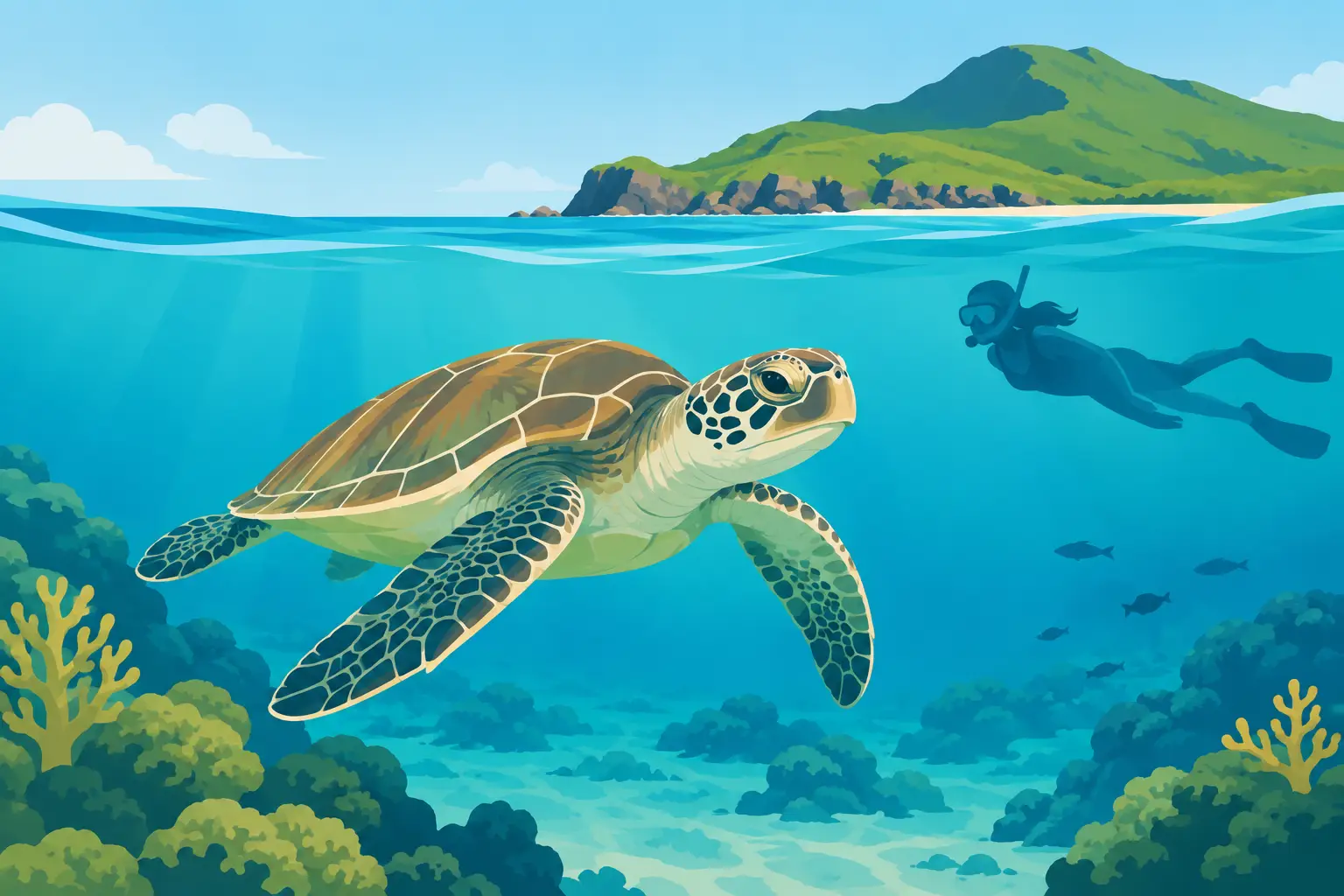
A sea turtle encounter in Statia is rarely arranged on cue. That is precisely part of its appeal. This Statia sea turtle guide is for travelers who prefer a wild sighting over a staged moment: a quiet shape rising for air beyond a reef, a hawksbill working patiently along coral, or tracks appearing in the sand under the right seasonal conditions.
St. Eustatius is not a destination built around crowded turtle excursions or guaranteed underwater photographs. Its marine environment is protected, its coastline can be energetic, and the most meaningful encounters happen when visitors give wildlife room to remain wild. For divers, snorkelers, and thoughtful beachgoers, that makes a turtle sighting a rare reward rather than another item on an itinerary.
Why Statia Is Different for Sea Turtle Encounters
The waters around this small volcanic island form part of a protected marine landscape, where reef systems, seagrass areas, rocky shorelines, and open Caribbean water support a broad range of marine life. Sea turtles may be seen while diving or snorkeling, and several species use the wider region for feeding, migration, and nesting.
The experience feels notably different from a resort island. There are no beach clubs lining every shore and no obligation to chase wildlife for a photograph. Instead, the day may begin with a boat dive, continue with lunch in Oranjestad, and end with a walk along a quiet beach where the island's volcanic slopes meet the sea.
That slower rhythm comes with a trade-off: sightings are never guaranteed. Visibility, currents, sea state, season, and plain luck all matter. Travelers who arrive expecting a dependable turtle spectacle may be disappointed. Those who see the encounter as one part of a larger island experience - alongside diving, hiking The Quill, and exploring the historic town - tend to find more value in it.
Which Sea Turtles Might You See?
Hawksbill turtles are among the species divers and snorkelers hope to encounter around Caribbean reefs. Their narrow, beak-like mouths are well suited to feeding among coral and sponges, and they can be remarkably well camouflaged against a reef wall or coral garden. Green turtles may also be seen, particularly in areas where they can feed, while loggerhead turtles are part of the region's wider marine ecosystem.
Identification is best left to a calm observation rather than a close inspection. Notice the shell shape, the turtle's size, and its behavior from a respectful distance. A local dive professional can often help identify what you saw afterward, without turning the moment into a pursuit.
If you are visiting during the nesting period, remember that a turtle on shore needs more space, not less. Nesting seasons and monitoring activity can vary by species and year. Follow any local guidance, temporary beach notices, and instructions from conservation teams or accommodation hosts.
A note on hatchlings and nests
A nest or hatchling is not an invitation to help. Artificial light, footsteps, noise, and well-intentioned handling can interfere with a turtle's natural path to the sea. Do not touch eggs, hatchlings, or adult turtles, and do not dig around a nest to investigate it.
If you find a turtle in distress, a disoriented hatchling, or evidence of a disturbed nest, keep people back and report it promptly to the appropriate local authorities or marine conservation contact. On a small island, word travels quickly, but a photo shared with a precise location can also draw an unwanted crowd. Use discretion.
Where to Look: Reef, Bay, and Beach
For most visitors, guided diving offers the best chance of seeing turtles in their natural underwater habitat. Statia's dive operators know the conditions, entry points, currents, and protected sites far better than a visitor can after reading a map. They also set the right tone: watch, float, and let the animal choose the distance.
Divers may find turtles along reef edges, near sponge-covered structures, or passing through blue water between sites. Keep your buoyancy controlled and avoid settling on the reef while waiting for a better angle. One careless fin kick can do more damage than a missed photograph ever will.
Snorkeling can be rewarding in calmer conditions, but it depends heavily on weather and local advice. Ask locally where conditions are safe on the day you wish to enter the water. Statia's shores are not uniformly gentle, and a beautiful-looking sea can still have surge, current, or difficult access. A turtle is never worth an unsafe swim.
Beaches have their own role, particularly for visitors interested in nesting conservation. Do not assume every beach is appropriate for swimming or nighttime wandering. Some coastal areas are remote, conditions can change quickly, and nesting habitat deserves a low-impact approach. If a guided or official monitoring opportunity is available during your stay, it is the most considerate way to learn more.
How to Behave Around a Sea Turtle
The essential rule is simple: let the turtle control the encounter. Never swim directly toward it, block its route to the surface, touch its shell, feed it, or position yourself above it. Turtles need to surface to breathe, and repeated interruption can change their behavior and drain energy they need for feeding, migration, or nesting.
Give the animal a wide, calm buffer. If it swims closer on its own, remain still rather than reaching out or following. Underwater cameras are welcome when used thoughtfully, but turn off flash and resist the temptation to chase a retreating turtle for a final shot.
On land, keep beaches dark and quiet at night. Avoid flashlights unless necessary for personal safety, and never shine a bright beam toward a turtle. If your accommodations are near the coast, close curtains and reduce exterior lighting where possible during nesting periods. Small choices protect the darkness hatchlings use to orient toward the horizon.
The same care applies to what you leave behind. Pack out every piece of trash, secure lightweight items on breezy days, and avoid single-use plastic when practical. A plastic bag in the water can resemble food to a turtle; fishing line and discarded packaging can entangle wildlife long after a visitor has flown home.
Planning a Turtle-Conscious Statia Trip
Build your itinerary around the island rather than around one hoped-for animal encounter. Book diving in advance if it is central to your trip, especially when island capacity is limited. Tell your operator your experience level and whether you are hoping to see turtles, but trust them to choose sites based on safety and conditions rather than a wildlife wish list.
Leave room for weather changes. Boat departures, snorkeling plans, and beach access can shift with wind and swell. This is normal island travel, not a service failure. A flexible schedule might pair dive days with a hike on The Quill, a visit to the island's heritage sites, or an unhurried afternoon in town.
Bring reef-safe sun protection, a reusable water bottle, and snorkeling gear only if you are comfortable using it in the conditions recommended locally. If you bring an underwater camera, practice with it before you encounter wildlife. The less you fuss with settings in the moment, the more present you will be.
For travelers staying several nights, patience is often the best strategy. One day in the water may bring a reef full of color and no turtles. The next may offer a brief, unforgettable glimpse of one moving effortlessly through the blue. Neither day is lesser.
Let the Encounter Stay Wild
A sea turtle is not a prop against a Caribbean backdrop. On Statia, it is part of a living marine world that has remained compelling precisely because it is not overmanaged for visitors. The privilege is not in getting closer than anyone else. It is in seeing the island, as it feels: quiet, protected, and still capable of surprise.
Travel gently, listen to local guidance, and allow the encounter to be brief. You may leave with no perfect image at all, yet with something more lasting - the memory of having been a respectful guest in a place that does not need to perform to be extraordinary.
