
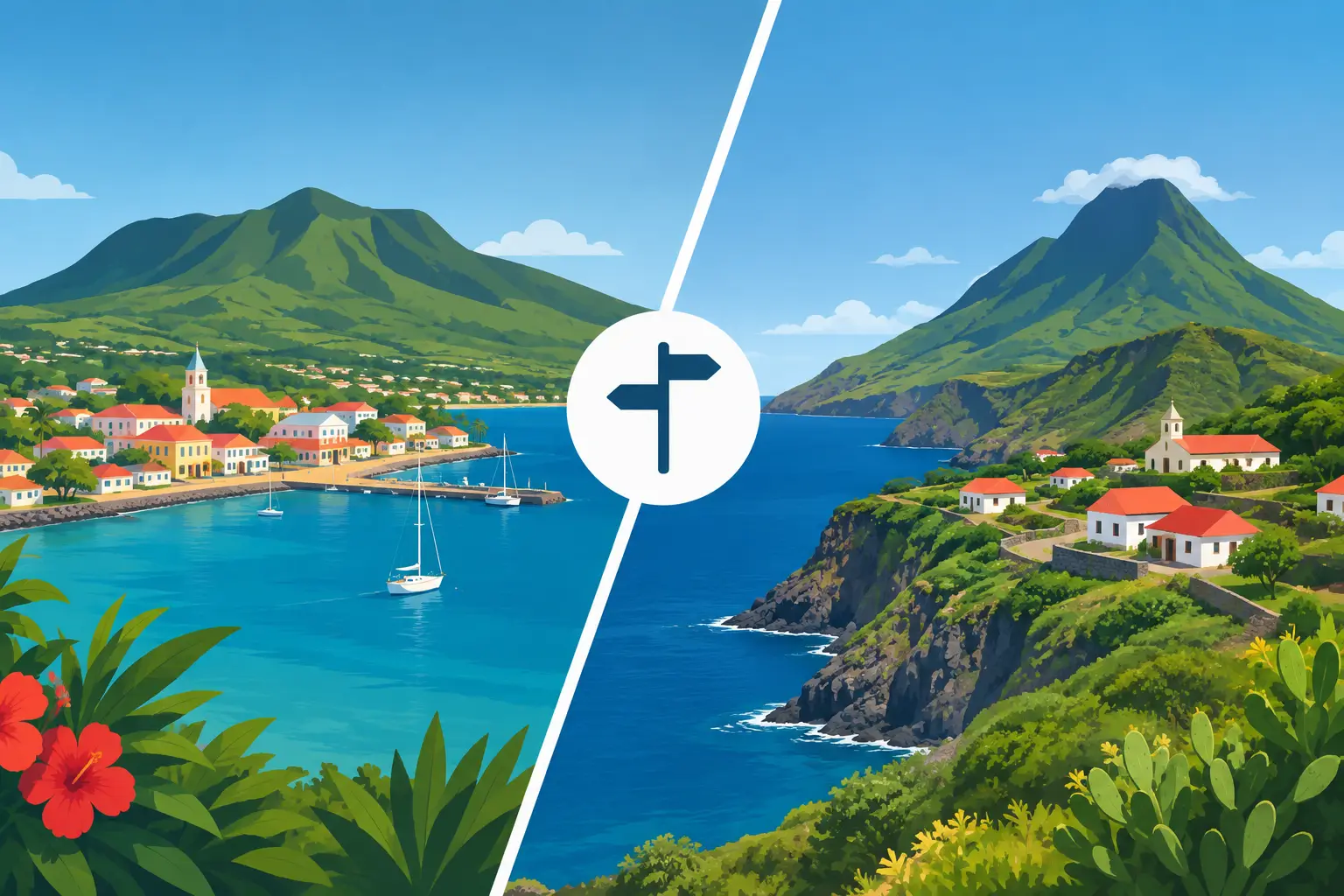
The choice between St Eustatius vs Saba is not really about finding the “better” Caribbean island. These neighboring Dutch Caribbean destinations share volcanic drama, clear water, small-scale hospitality, and a welcome absence of resort crowds. Yet they ask different things of a traveler. Saba is steep, green, and immediately physical. St. Eustatius, known locally as Statia, is broader in mood: a place where underwater reserves, a sleeping volcano, and centuries of Atlantic history sit within a remarkably gentle rhythm.
For travelers who would rather discover than arrive, both are a rare reward. The right choice comes down to how you want your days to feel once you are there.
St Eustatius vs Saba: The essential difference
Saba rises sharply from the sea. Its mountain roads, impossibly perched villages, and cloud-wrapped slopes give it a sense of seclusion from the moment you land or come ashore. The island is compact, rugged, and beloved by travelers who want to hike, dive, and settle into a place that feels far removed from ordinary life.
St. Eustatius has a more open geography and a more layered story. The Quill volcano defines the southern end of the island, while the historic town of Oranjestad steps down toward the sea. Its landscapes move from dry coastal trails and cliffs to rainforest inside a volcanic crater. You can spend a morning following the remains of a once-powerful trading port, then descend into warm blue water above a reef or historic wreck.
Choose Saba if you want the Caribbean at its most vertical and village-centered. Choose Statia if you want more room to roam, a stronger sense of history, and an island whose pleasures unfold gradually.
For divers: reefs, wrecks, and the kind of quiet you remember
Both islands have protected marine environments and are especially appealing to experienced divers, underwater photographers, and travelers who prefer healthy reefs to crowded boat schedules. Neither is built around high-volume dive tourism. That is part of the appeal, but it also means reserving ahead is wise, particularly during busier travel periods.
Saba is famous for dramatic underwater topography. Its marine park includes pinnacles, volcanic formations rising from deeper water, and sites that can feel wonderfully wild. Conditions and site selection depend on weather and experience level, but Saba often suits divers drawn to deep blue water, walls, and striking volcanic structure.
Statia offers a different kind of underwater richness. Marine park dives may combine lava formations, reef life, anchors, cargo remnants, and wrecks that speak to the island’s maritime past. The waters around the island can be exceptionally calm, and the range of sites makes it rewarding for divers with different experience levels. There is a satisfying sense that the island’s story continues below the surface.
If your ideal dive day means pinnacles and dramatic contours, Saba may be your pull. If you want reef life, wrecks, and a broader historical dimension between dives, St. Eustatius is hard to overlook. In either place, confirm operators’ schedules, certification requirements, and weather plans directly before making fixed connections.
For hikers: a summit challenge or a crater forest
Saba’s signature experience is Mount Scenery. Reaching its summit is a real outing, not a casual stroll. The trail involves many stone steps, changing vegetation, humidity, and often cloud forest conditions near the top. On a clear day, the views can be extraordinary. Even when the summit is misty, the journey through the island’s lush interior has its own atmosphere.
On Statia, the Quill is the defining hike. The trail climbs through dry forest before entering a deep, green crater that feels unexpectedly enclosed and alive. This is one of those Caribbean walks that changes your sense of the island: from the coast, the Quill appears composed and quiet; inside, its slopes hold dense vegetation and birdsong. Some routes require a local guide, and that requirement is worth treating as part of the experience rather than a complication.
Statia also offers a wider variety of walks beyond its volcano. Coastal paths, historic landscapes, and northern trails give non-summit hikers more options across several days. Saba is the better fit for travelers seeking a concentrated mountain challenge. Statia suits those who want hiking to be one part of a larger island itinerary.
For history and culture: Statia has the deeper archive
This is where the distinction becomes clearest. Saba’s heritage is tangible in its red-roofed cottages, its famously engineered roads, and its self-contained village life. It feels intimate and distinctive, with traditions shaped by generations of people living on a steep island with limited land and a close relationship to the sea.
But St. Eustatius has an unusually expansive historical presence for such a small island. In the 18th century, Statia was one of the Caribbean’s great free ports, a place where goods, news, and people moved through the Atlantic world. Its recognition of the American flag in 1776 remains an important chapter in American history, while the warehouses, fortifications, ruins, and historic streets around Lower Town and Oranjestad give the past a physical presence.
This is not history kept behind glass. You encounter it while walking to dinner, looking down from Fort Oranje, or following a path toward the shoreline. Travelers who enjoy colonial architecture, maritime history, archaeology, and the complicated stories behind Caribbean trade will find more to stay with them on Statia.
Where the days feel different
Neither island is for travelers looking for nightlife districts, polished shopping promenades, or an all-inclusive itinerary planned minute by minute. Restaurants, accommodations, dive operators, and transportation all work on a smaller scale. That calls for a little advance planning and a willingness to let the island set the pace.
Saba feels especially contained. Its villages offer a close-knit rhythm, and its terrain naturally shapes your day. You may spend the morning hiking, take a slow lunch overlooking the sea, then return to your accommodation before dinner. It is a fine choice for couples and independent travelers who want to read, walk, dive, and be pleasantly removed from distraction.
Statia feels more spacious in both landscape and possibility. There are small hotels, guesthouses, local dining, snorkeling, hiking, diving, and heritage sites to combine without making the day feel overfilled. Oranjestad provides a practical center for meals and historic wandering, while the island’s roads make it relatively easy to reach different trailheads and viewpoints. Renting a vehicle can add welcome freedom, though availability is limited and should be arranged early.
Getting there: flexibility matters on both islands
Access is part of the adventure, and it is also the detail most likely to require patience. Flights and ferry connections in the northeastern Caribbean can be affected by weather, operational changes, and limited frequency. Build extra time around international arrivals and avoid planning a same-day connection to a long-haul departure whenever possible.
Saba’s famously short runway is an experience in itself, but it also underlines the island’s compact, weather-sensitive character. Statia is likewise reached through regional connections, often via nearby hubs. The best routing depends on your starting point, the season, and current carrier schedules.
For either island, confirm flight and ferry timing directly before booking accommodations, dive packages, or onward travel. A slightly longer stay is often more valuable than a tightly engineered one. These are places that reward time, not speed.
Which island should you choose?
Choose Saba if your ideal escape is steep, lush, and intensely quiet. It is especially well suited to confident hikers, divers drawn to pinnacles and walls, and travelers who like the idea of waking up in a mountain village above the Caribbean Sea.
Choose St. Eustatius if you want volcanic nature with more variety around it: crater hiking, protected diving, archaeological traces, historic streets, and a local pace that leaves room for unplanned afternoons. It is a particularly strong choice for couples, history-minded travelers, and divers who want their time above water to carry as much texture as their time below it.
There is, of course, a third answer. If your itinerary allows, visit both and resist the urge to treat either as a quick stop. Give Saba time to reveal its altitude and stillness. Give Statia time to reveal its layers. On a small island, an extra day can be the difference between seeing a place and beginning to feel it.
