
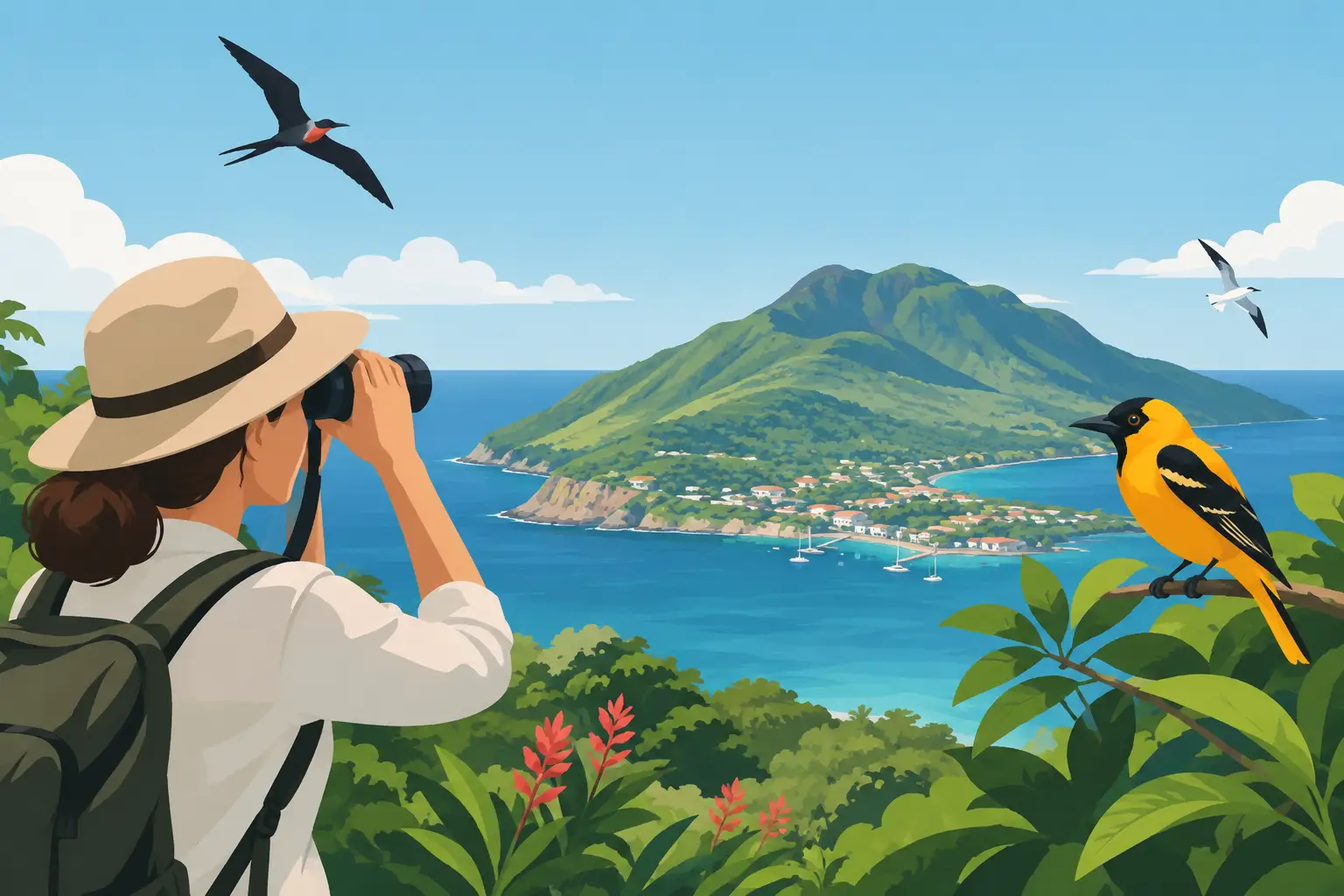
The first call may come from a thicket above the coast, before the trail has properly warmed up. A hummingbird flashes through flowering shrubs, a seabird rides the trade winds beyond the cliffs, and the island feels suddenly much larger than its map suggests. This St Eustatius birdwatching guide is for travelers who like their nature experiences unhurried, lightly planned, and close to the character of the place.
Statia is not a birding destination built around hides, big tour buses, or a checklist completed before lunch. Its reward is subtler: volcanic forest, dry scrub, saltwater edges, historic slopes, and an offshore horizon busy with life. For visitors who would rather discover than arrive, birdwatching is a fine way to notice the island, as it feels.
Why birdwatching on Statia feels different
St. Eustatius sits on a migration route and packs varied habitats into a compact island. Within a short drive of Oranjestad, the dry, sunlit vegetation of the lower slopes gives way to wetter forest on The Quill, while dramatic east-coast viewpoints bring pelagic birds and soaring frigatebirds into view. Seasonal visitors can change the experience considerably, especially around migration periods.
The island does not promise easy sightings of every Caribbean specialty. That is part of its appeal. A productive morning may mean lingering over familiar species seen in a new setting: Bananaquits working blooms, Pearly-eyed Thrashers moving through fruiting trees, or Antillean Crested Hummingbirds hovering at eye level. Along open shorelines, Brown Pelicans and Magnificent Frigatebirds are often more conspicuous, using the wind rather than fighting it.
For serious birders, Statia works best as a focused stop within a longer Caribbean itinerary or as a nature-rich layer to a diving, hiking, or heritage trip. For curious travelers, it is simply a reason to slow down and look up.
Where to go in this St Eustatius birdwatching guide
The Quill: forest birds and a cooler morning walk
The Quill is the island's defining volcanic landmark, and its trails offer the strongest contrast to the coast. As you climb, vegetation becomes denser and the air often feels cooler. The forest is better appreciated slowly, with frequent stops to listen rather than a determination to reach the crater as fast as possible.
Early morning is the best time to start. Song and movement are easier to detect before heat, hikers, and wind build later in the day. Watch the canopy and the vegetation at trail level, where small birds can be surprisingly active but hard to separate from the leaves.
The crater route is a hike first and a birding walk second. Conditions can be steep, muddy, and slippery after rain, so wear proper shoes, carry water, and give yourself enough daylight. Access conditions and guide expectations can change, particularly on protected trails, so confirm the current arrangement locally before setting out. A local guide can add real value here, not only in finding birds but in reading the forest, weather, and trail conditions.
Boven and the northern hills: open country and wide views
The north of the island has a more open, windswept character. Boven National Park and the surrounding hills combine scrub, grassland, rocky ground, and broad sea views. It is a good landscape for travelers who enjoy walking with binoculars rather than standing in one place.
This is where the island's scale becomes part of the experience. Raptors or seabirds may appear as silhouettes against bright skies, while smaller resident birds move low in brush and cactus. Wind can make both birding and photography more difficult, so use it to your advantage: scan ridgelines, sheltered gullies, and leeward slopes where birds may be feeding out of the gusts.
Bring sun protection and more water than you think you need. Shade is limited, and the island's beauty can make a route seem shorter than it is.
The coast: seabirds, shorelines, and changing light
Statia's coastal birdwatching is less about ticking off a long list and more about paying attention to the conditions. Look from elevated points along the east coast when trade winds are active, then scan calmer bays and shoreline edges for feeding activity. Brown Pelicans are regular companions near the water, while frigatebirds can hang almost motionless above the island before tilting away on a gust.
Morning light is generally kinder for viewing and photographs, but late afternoon has its own atmosphere. The sea takes on depth, the cliffs cool, and birds crossing the horizon become part of a larger coastal scene. Keep a respectful distance from nesting areas and avoid approaching cliffs or shorelines simply for a closer image. On a small island, habitat is not an attraction set apart from daily life. It is the living ground beneath it.
Timing your visit around weather and migration
There is no single best month for every birder. Resident species make birdwatching worthwhile throughout the year, while spring and fall migration can bring additional variety. Rain can also transform the feel of the island, encouraging growth and changing where birds feed, though wet trails may make hiking less practical.
If birds are the central purpose of your trip, allow at least three mornings on island. One can be reserved for The Quill, another for the north, and a third for revisiting whichever habitat felt most alive. This is more useful than trying to cover every corner in a single day, especially when weather shifts or a promising trail deserves extra time.
Plan for an early start, a shaded midday break, and a second, shorter outing later in the afternoon. That rhythm suits both birds and travelers. It also leaves room for the pleasures that make Statia memorable beyond a field notebook: a quiet lunch, a swim, a walk through historic Oranjestad, or a conversation that changes your plans for tomorrow.
What to bring, and what to leave behind
A compact pair of binoculars, a hat, refillable water bottle, rain layer, and shoes with grip are more useful than a large amount of gear. A camera with a modest telephoto lens can be rewarding, but do not let it turn every encounter into a pursuit. On wooded trails, the first clear look is often brief. Learn the shape, movement, and call before reaching for the camera.
Offline bird identification resources can help, as cellular coverage and batteries are not something to assume on remote trails. Download what you need before leaving your accommodation. A small notebook is also worth carrying. Record the date, location, weather, and behavior, not just the species name. These details make the sighting more meaningful and can help you recognize patterns during the rest of your stay.
Avoid playing bird calls to draw birds closer. In a small, protected environment, repeated playback can disrupt feeding, breeding, and normal behavior. The better approach is patient observation: stand still, lower your voice, and let the habitat settle around you.
Birdwatch with care on a small island
Good birdwatching on Statia is guided by restraint. Stay on established paths, respect private land, and do not cross fences or scramble down unstable slopes for a sighting. Keep distance from birds on nests, near chicks, or resting along the shore. If an animal changes its behavior because of your presence, you are too close.
This matters especially because the island's ecosystems are connected. A morning spent watching seabirds from the coast is also an encounter with the marine environment below. A walk in the forest is part of the same conservation story that protects trails, reefs, and native plants. Visitors who move gently through these places help preserve the rare reward of seeing them feel genuinely wild.
Make birding part of a fuller Statia stay
Birdwatching fits naturally between other island experiences. Start with a forest walk, then spend the afternoon underwater with a diving operator or snorkeling in clear coastal water. Choose another day for the island's history, from the Lower Town and its warehouses to the roads and ruins that give Oranjestad its distinctive sense of time. The same attentiveness that finds a small bird in the canopy makes these places richer, too.
Build your itinerary with flexibility. Accommodations, guides, transport, and outdoor activities have limited capacity, and schedules can shift with weather or local operations. Confirm plans directly and leave a little open space in the day. The sighting you remember may not be the rarest bird on the island. It may be the one that appeared when you had nowhere else you needed to be.
