
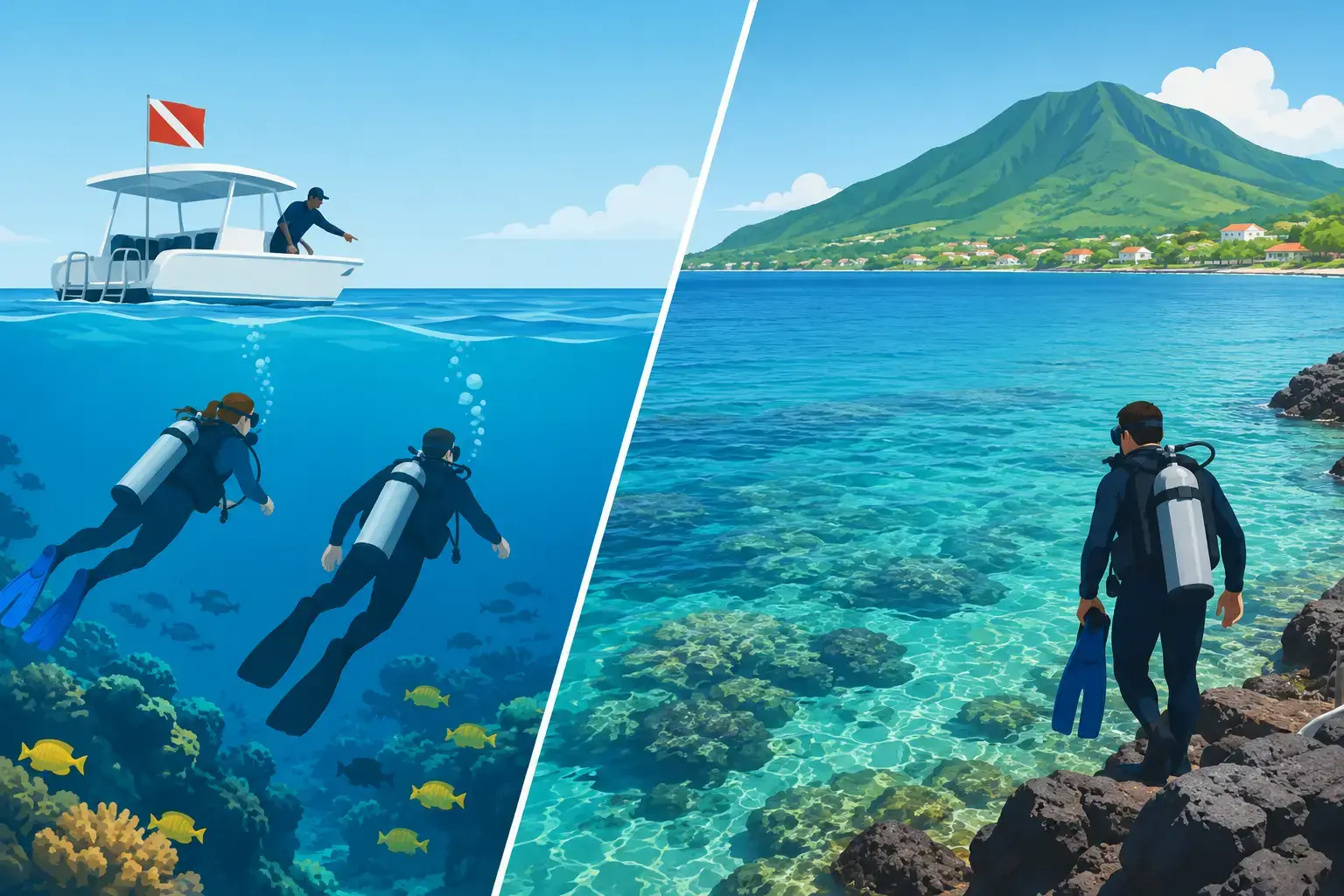
The choice between guided versus shore diving changes more than the price of a day underwater. It shapes how much of St. Eustatius you see, how independently you move, and how confidently you read an island coastline that can look calm from shore while telling a different story below the surface. For many visitors, a guided boat dive is the natural introduction. For experienced, self-sufficient divers, shore diving may offer a quieter kind of freedom - when conditions, access, and local rules allow.
St. Eustatius is not a resort island built around easy, repeatable dive routines. Its volcanic profile, protected waters, and uncrowded pace reward preparation. The right choice depends on your certification, comfort in changing conditions, the equipment you have available, and what you hope to find beneath the waterline.
Guided versus shore diving: the essential difference
A guided dive places the local judgment with someone who knows the water well: the boat captain, dive guide, and operator team. They select sites according to weather, currents, visibility, your experience level, and the day’s marine conditions. On St. Eustatius, that knowledge can open access to offshore reefs, wrecks, and deeper sites that are simply beyond the reach of a shore entry.
Shore diving puts more of that judgment in your hands. You choose the entry point, manage the navigation, carry or arrange your gear, assess the surf and current, and set your own profile. That can be deeply satisfying for divers who know how to plan conservatively and prefer an unhurried schedule. It also comes with limits. A beach that appears convenient is not automatically a suitable diving entry, and a familiar shore-diving routine from Bonaire, Curaçao, or Hawaii should not be assumed here.
The distinction is not about one approach being better. It is about matching the day to the island, and matching your experience to the day.
Why guided diving is often the better first choice
For a first dive on Statia, a local operator gives you context that no site map can fully provide. The island’s dive landscape includes volcanic formations, coral communities, historic anchors, and wreck sites. Local guides know which moorings are most protected from the wind, when a current is likely to build, and where a small change in conditions can affect visibility or comfort.
Boat diving also expands the range of what you can see. Rather than limiting the day to a reachable entry point, you may visit sites along the island’s coast chosen for the conditions at hand. A guide can help newer divers refine buoyancy and air management, while experienced divers can spend more time observing the details that make Statia’s marine environment distinctive: schooling fish moving over reef structure, sponges on volcanic slopes, and the quiet evidence of a coast shaped by geology and trade.
There is a practical comfort to guided diving, too. Tanks, weights, transport, site briefings, surface support, and emergency procedures are generally organized through the operator. On a small island, where rental inventory and schedules can be limited, this can make a meaningful difference to how relaxed your trip feels.
Guided trips are particularly worthwhile if you are newly certified, returning to diving after time away, traveling without a buddy, unfamiliar with Caribbean currents, or eager to explore deeper or offshore sites. They are also a strong choice for couples whose experience levels differ. A thoughtful operator can select an appropriate site and pace rather than asking one diver to compromise the whole day.
That support does not mean a passive experience. The best guided dives still leave room for curiosity. Let the guide know whether you care most about wide reef scenery, marine life, photography, wrecks, or a gentler first day. On an island this personal in scale, a clear conversation can shape the experience.
What shore diving asks of you
Shore diving offers a different pleasure: you can move at your own rhythm. There is no boat departure to meet, no fixed return time, and no need to follow another group’s profile. If conditions are favorable and independent diving is approved for the site, an early entry can be a peaceful way to begin the day before turning toward a hike, a long lunch in Oranjestad, or an afternoon above the water.
But shore access on St. Eustatius should be treated as a local question, not an assumption. Ask a dive operator about current entry options, site suitability, marine-park guidance, weather exposure, and any requirements for independent diving. Conditions can change with wind direction and swell, while rocky or uneven entries may demand more balance, planning, and physical ease than a sandy beach entry elsewhere.
Independent divers should be comfortable with full self-management. That includes checking equipment, arranging tanks and weights, setting a conservative turnaround pressure, navigating back to the entry point, and calling the dive when conditions shift. A reliable buddy is essential. So is the willingness to decide that a planned dive is not a good dive today.
Shore diving can be a good fit if you have substantial recent experience, have already learned the island with a local professional, and want a flexible extra dive around a guided itinerary. It may be less appealing if you are on a short visit and do not want to spend valuable vacation time carrying gear, researching entries, or waiting for a more favorable sea state.
Compare the trade-offs before you book
The clearest advantage of a guided dive is access. A boat can reach sites that reveal a fuller picture of Statia’s underwater world, often with easier entries and more dependable site selection. You also receive local interpretation, which can turn a beautiful reef into a more memorable encounter with the island’s natural history.
The advantage of shore diving is autonomy. You set the pace, and a well-timed independent dive can feel wonderfully private. It can also be less expensive per dive in some destinations. Yet cost needs to be viewed honestly. Tank rental, weights, transportation, gear handling, and the possibility that conditions cancel your plans all affect the value calculation. Guided diving may cost more upfront while delivering more usable time underwater.
Then there is the question of confidence. A guide does not remove the need for sound diving skills, but local supervision can reduce uncertainty in an unfamiliar place. Shore diving asks for a higher degree of personal judgment before you even descend. Neither model guarantees a perfect day. Weather remains in charge, and good operators will alter plans or postpone a trip when that is the responsible decision.
A practical way to build your dive days
For most visitors, the most rewarding approach is not choosing one style for the entire trip. Start with one or two guided boat dives. You will gain a sense of the island’s conditions, learn what is currently active underwater, and see sites that define St. Eustatius as a dive destination.
After that, speak directly with your operator about whether independent shore diving makes sense during your stay. Be specific about your certifications, recent dives, whether you have your own buddy, and what equipment you need. Confirm departure times, rental availability, weather policies, and any local procedures before you plan the rest of the day around a dive.
If you are deciding between a guided trip and an independent entry on a single free morning, choose the option that leaves the fewest uncertainties. St. Eustatius is a rare reward precisely because it has not been engineered into an effortless, mass-market itinerary. Let the island set the pace, and save your independent dive for the day when the sea, the access, and your own readiness all agree.
