
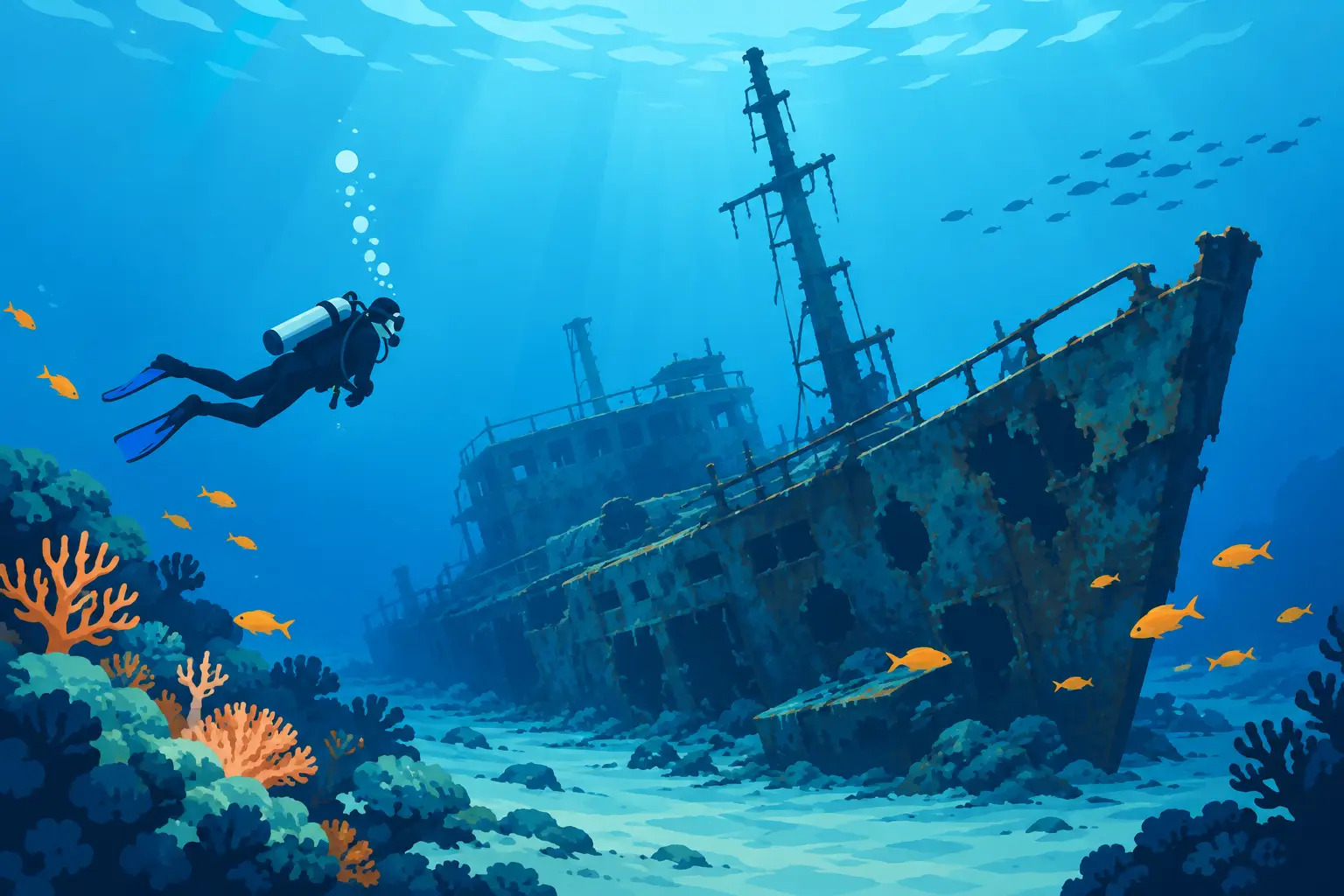
A wreck can make a dive feel like a found story: a freighter softened by coral, a wheelhouse bright with silversides, a familiar shape slowly returning to the reef. The best Caribbean dive wrecks are not all deep, dramatic steel structures. Some are wide enough for a first wreck specialty course; others demand buoyancy control, experience, and a real appetite for depth. What they share is a sense of place - each has become part of its island’s underwater character.
For travelers willing to look beyond the obvious resort itinerary, the Caribbean offers remarkable range. Bonaire’s wrecks sit in famously calm water, Grenada has a giant that rewards technical ambition, and St. Eustatius offers purposeful wrecks within a protected marine environment where the surrounding reef is as memorable as the hull itself.
Best Caribbean dive wrecks for different kinds of divers
Charles L. Brown, St. Eustatius
The Charles L. Brown is the wreck that many experienced divers come to Statia hoping to see. This former cable-laying vessel was intentionally sunk in 2003 and rests upright at roughly 100 feet, with deeper sections below. Its scale is striking, but so is the life around it: schooling fish gather over the deck, sponges color the railings, and the ship’s structure creates a convincing sense of exploration without losing the calm, uncrowded feeling that defines the island.
This is generally a dive for advanced divers, particularly when bottom time and currents are considered. Conditions can change, and local operators choose sites according to the day. That care is part of the appeal. On a small island, a good wreck dive is not rushed through on a timetable; it is planned around sea conditions and the divers in the group.
Chien Tong, St. Eustatius
For a more accessible Statia wreck, the Chien Tong is a rewarding counterpoint. The former Taiwanese fishing vessel sits in shallower water, around 60 feet, and has developed into a lively artificial reef. Barracuda, snapper, and reef fish move around its open structure, while the nearby coral reef adds variety to the dive.
The Chien Tong often suits divers who have some experience but are not seeking the depth profile of the Charles L. Brown. It is also a fine choice for photographers, since the light is kinder and the wreck can be enjoyed at an unhurried pace. Pairing these two sites gives a useful picture of why Statia is a rare reward for wreck divers: the wrecks are compelling, but never separated from the island’s protected volcanic seascape.
Hilma Hooker, Bonaire
The Hilma Hooker is among the Caribbean’s most recognizable wreck dives, partly because it looks so naturally dramatic. The cargo ship rests on its starboard side off Bonaire, beginning near 60 feet and sloping down past 100 feet. Its hull is heavily encrusted, its open holds draw fish, and its angled position makes every pass feel a little theatrical.
Bonaire is especially well suited to independent-minded divers because of its shore-diving culture, but the Hilma Hooker is not a casual entry-level site. Depth, surface conditions, and navigation deserve respect. Go with a local operator if you want guidance on the day’s conditions, or if this is your first time managing a deeper Caribbean wreck profile.
Superior Producer, Curaçao
Off Curaçao’s capital, the Superior Producer is a compact, beautifully overgrown cargo ship that delivers far more atmosphere than its size suggests. The wreck begins around 65 feet, with the deeper portion near 100 feet. Coral, tube sponges, and dense marine life have made it feel less like a ship on the seafloor than a small reef with a steel backbone.
Its location and photogenic profile make it popular, so an early departure can make a difference. This is a strong option for advanced recreational divers who want a focused wreck dive with enough detail to reward slow observation.
Tugboat, Curaçao
Curaçao’s Tugboat is proof that memorable wrecks do not need to be deep. Lying in shallow water near Caracasbaai, this small tug is surrounded by coral growth and is often paired with snorkeling or a relaxed afternoon dive. The maximum depth is modest, making it approachable for newer divers and useful as a gentle reorientation dive after travel.
Do not expect the scale of a freighter. Come for color, easy light, and the pleasure of seeing a humble working vessel become part of the reef. It is an excellent reminder that the best wreck is sometimes the one that fits the day you actually have.
Antilla, Aruba
The Antilla is one of Aruba’s great underwater landmarks: a German cargo ship from the Second World War, deliberately sunk in 1940 and now blanketed in marine growth. At more than 400 feet long, it feels expansive even in the relatively shallow water where it rests. Divers can follow railings, peer into openings, and watch clouds of fish gather along the superstructure.
Because the Antilla is often exposed to wind and surface movement, visibility can vary. Its shallow depth makes it broadly accessible, but an easy depth should not be mistaken for an easy day. If swell is up, choose a local operator with the flexibility to suggest another site.
SS Antilla’s counterpart: Shakem, Aruba
For divers who prefer a smaller wreck with a more intimate feel, Aruba’s Shakem offers a different kind of immersion. This former cargo vessel rests around 60 to 100 feet and is known for its coral-coated structure, schools of fish, and occasional larger visitors in the blue. It is a better fit for divers who want to spend time examining a wreck rather than trying to take in a giant ship all at once.
The comparison with the Antilla is useful when planning Aruba. Choose the Antilla for scale and history; choose the Shakem for a deeper, quieter look at reef life settling into steel.
USS Kittiwake, Grand Cayman
The USS Kittiwake, a former U.S. Navy submarine rescue vessel, was sunk off Grand Cayman as an artificial reef in 2011. Resting in clear water with much of the structure within recreational limits, it offers wide decks, distinct rooms, and an imposing silhouette that is easy to appreciate. The site can suit a range of certification levels, depending on the route and conditions.
The Kittiwake’s appeal is its clarity of form. You can recognize the working purpose of the vessel while watching it transform into habitat. Its popularity means planning ahead is wise, especially during busy travel periods.
MV Captain Keith Tibbetts, Cayman Brac
Cayman Brac’s Captain Keith Tibbetts offers something the Kittiwake does not: a wreck dramatically affected by nature. The former Soviet frigate was split by a storm, leaving sections that feel both monumental and slightly surreal. The bow remains a favorite, with guns and superstructure creating strong photographic lines.
This is a destination for divers who enjoy the wreck as much as the island’s slower pace. Cayman Brac is less built-up than Grand Cayman, and that quieter setting complements a shipwreck with genuine presence.
RMS Rhone, British Virgin Islands
The RMS Rhone is not an artificial reef, but a historic shipwreck with a different emotional weight. This Royal Mail steamer sank in a hurricane in 1867 near Salt Island, and its remains spread across a site that can be explored at varying depths. Propeller, boilers, bow sections, and coral formations make the dive feel layered rather than linear.
The Rhone has enough depth and complexity to interest seasoned divers, yet parts of the site are suitable for less experienced guests when conditions allow. It is especially compelling for travelers who want maritime history without leaving the warmth and color of a Caribbean reef behind.
Bianca C, Grenada
Known as the Titanic of the Caribbean, Grenada’s Bianca C is a large, deep wreck for divers with the training to appreciate it properly. The Italian cruise liner sank in 1961 and now lies in waters that place much of the experience beyond ordinary recreational limits. Its immense form, often appearing from the blue, can be unforgettable.
This is not a site to chase simply because of its reputation. Nitrox, deep-diving experience, excellent buoyancy, and an operator who is candid about conditions all matter. For the right diver, though, the Bianca C is one of the region’s true big-water experiences.
Planning a Caribbean wreck-diving trip
A better trip is built around your actual certification, not a wish list. Many wrecks have shallow upper sections but deeper decks, sand channels, or nearby drop-offs. Ask operators for the likely maximum depth, the expected current, whether penetration is permitted, and how much experience they want before booking. Penetration should never be assumed, even on a wreck with open-looking doorways.
It also pays to leave room for reefs. Wrecks are often the headline, but the Caribbean’s strongest dives frequently combine both: a ship resting beside coral, a volcanic wall just beyond the mooring, or a reef that draws the fish making the wreck feel alive. On Statia, that connection is especially clear. The island’s wrecks belong to a marine park shaped by volcanic slopes, clear blue water, and an unhurried rhythm above the surface.
Choose one wreck that stretches your experience and one that lets you slow down. The most satisfying Caribbean dive trips leave space for both the exhilaration of a ship appearing below and the quieter moments afterward, when the island is still asking to be discovered.
