
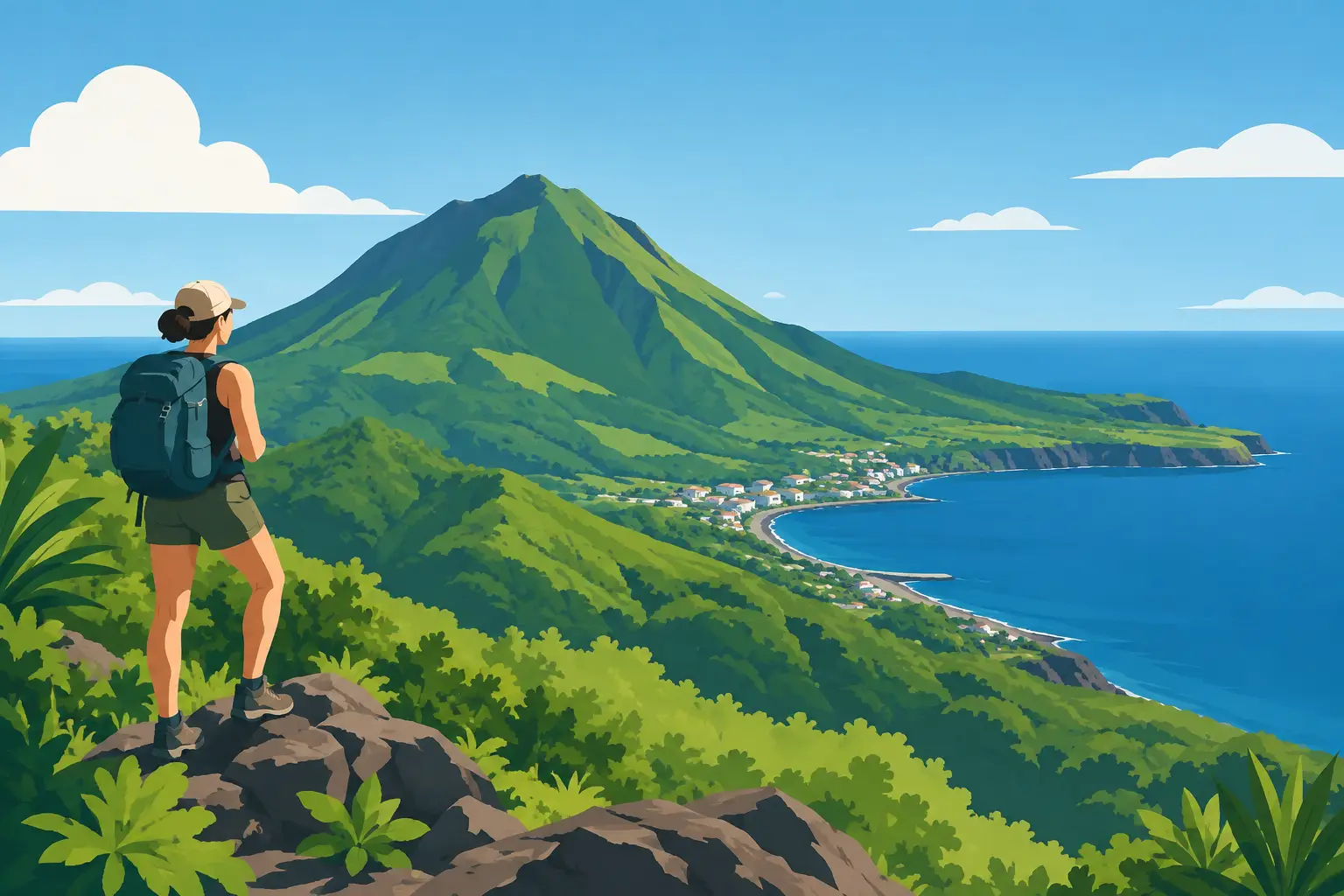
Boven National Park is where St. Eustatius feels most untamed. The island’s quieter north rises in a sequence of dry forested hills, open slopes, old grazing land, and volcanic ridges, with the Caribbean and Atlantic never far from view. This Boven National Park guide is for travelers who would rather spend a morning following a path through birdsong than settling into a resort schedule.
The reward is not a single famous lookout or a carefully staged attraction. It is the sense of moving through a landscape that still belongs to itself. On a clear day, the northern hills reveal the shape of Statia at its most elemental: a small island, a big horizon, and room to breathe.
What Makes Boven Different
Boven National Park protects much of northern St. Eustatius, a landscape quite distinct from the lush slopes of The Quill in the south. The terrain here is generally drier and more exposed, shaped by a chain of extinct volcanic hills rather than one dominant cone. Expect thorny scrub, grassland, pockets of seasonal forest, rocky ground, and broad sea views that can change character with the weather.
This is not a polished park experience with visitor centers at every trailhead or refreshments waiting at the end of a loop. Its appeal lies in that relative simplicity. You are walking through a protected Caribbean landscape where goats, birds, trade winds, and changing light set the pace.
For hikers, Boven offers a valuable counterpoint to The Quill. The Quill is dramatic, steep, and green, especially within its crater. Boven feels wider, drier, and more open to the island’s maritime setting. If time allows, experiencing both provides a fuller understanding of Statia’s volcanic character.
Choose the Right Kind of Hike
A Boven outing can be a gentle nature walk, a more demanding ridge hike, or part of a longer exploration of the island’s northern side. The right choice depends on your fitness, the recent weather, and whether you want to focus on views, wildlife, or simply time outdoors.
The hill country includes recognizable high points such as Signal Hill, Bergje, and Gilboa Hill. Routes may cross uneven volcanic terrain, loose stone, tall grass, and sections where vegetation narrows the path. A route that feels easy in dry, calm conditions can become more challenging after rain or during strong winds.
For first-time visitors, a local guide can make the experience considerably richer. Guides know current trail conditions and can point out the plants, birds, historical traces, and coastal views that are easy to pass without context. Guided hiking is especially sensible if you are unfamiliar with tropical terrain, are visiting during a wet spell, or want to take a less-traveled route.
Independent hikers should be realistic about navigation. Do not assume every visible track is a maintained public trail, and do not rely solely on a downloaded map. Before setting out, confirm the appropriate route and access arrangements with the local park authority or a knowledgeable island operator.
The Best Time to Visit Boven National Park
Start early. Morning is cooler, wildlife is more active, and the light across the northern slopes is often beautiful before the day turns bright. Beginning around sunrise also gives you a better margin for an unhurried return, which matters on an island where shade can be limited.
The dry months usually make for firmer footing and more comfortable hiking, but Statia’s weather is variable throughout the year. Brief showers can arrive quickly, while wind can make exposed ridges feel cooler than expected. In wetter periods, vegetation is often more vivid, though trails may be slippery and mosquitoes more noticeable in sheltered areas.
Avoid planning your hike around the hottest part of the afternoon. The Caribbean sun is strong even when a breeze makes the temperature feel manageable. If you want a slower, more contemplative visit, consider a short early walk followed by a late lunch in Oranjestad, rather than trying to cover the whole park in one push.
What You May See Along the Way
Boven is rewarding for travelers who enjoy noticing the smaller details. Keep an eye out for land birds moving through the brush, raptors circling above the hills, and seabirds riding the air currents along the coast. The park’s vegetation is adapted to sun, wind, and periods of dryness, giving the landscape a sculptural quality that is very different from the rainforest feel of The Quill.
You may also encounter free-roaming livestock. Give animals space, do not feed them, and take care around fences and uneven ground. This is a working island as well as a protected one, and its landscapes reflect both natural processes and a long human history.
The views are part of the wildlife experience, too. From higher ground, the sea becomes a moving field of blue, with neighboring islands sometimes visible on clear days. Bring binoculars if you have them. They add another layer to the walk, whether you are watching birds, scanning the coastline, or lingering over the distant horizon.
Prepare for a Self-Reliant Morning
Boven asks a little more of visitors than a resort-side walk, but preparation is straightforward. Wear closed-toe shoes with reliable grip rather than sandals. Choose lightweight clothing that covers shoulders and legs where possible, and bring a hat, sunscreen, insect repellent, and more water than you think you will need.
A fully charged phone is useful, but do not treat it as your only safety plan. Signal can vary, and the island’s limited scale does not remove the risks of heat, dehydration, a turned ankle, or losing the route. Tell someone where you are going and when you expect to return, particularly if hiking without a guide.
Carry out everything you bring in. There are no reasons to leave a bottle, snack wrapper, or fruit peel behind in a protected landscape. Stay on established paths where possible, avoid disturbing wildlife, and never remove plants, rocks, or other natural materials. These small choices help preserve the quiet that makes Boven special.
Pair Boven With the North Side of Statia
A Boven hike fits naturally into a day that moves at the island’s own pace. After an early walk, spend time around the northern coast, stop at a viewpoint if conditions permit, or return to town for a relaxed meal. There is no prize for rushing through every sight on a small island.
Travelers interested in history can also see Boven as part of a larger Statia story. The hills and coastlines of the north have long shaped how people moved, farmed, watched the sea, and made a life on the island. A guide can bring those connections into focus, turning a scenic hike into a more layered encounter with place.
If your trip includes diving or snorkeling, Boven offers a satisfying land-based complement to Statia’s marine world. One day you may be following reef contours underwater; the next, looking out from a volcanic ridge toward the same surrounding sea. The island, as it feels, is best understood from both perspectives.
Practical Notes Before You Go
Park access, trail conditions, and guided hike availability can change, especially after heavy rain or during periods of maintenance. Confirm current details directly before making firm plans, and reserve a guide in advance when possible. St. Eustatius has limited capacity by design, which is part of its charm but also a reason not to leave specialized activities until the last minute.
A rental vehicle or arranged transport is useful for reaching northern trail areas, since this is not a destination built around frequent public transportation. Drive slowly on island roads, respect private property, and remember that a short distance on a map may take longer than expected once you factor in road conditions and stops for views.
Boven National Park does not need to be conquered. Give it a cool morning, good footwear, enough water, and the attention you might bring to a place that has no need to perform for you. That is when its quiet ridges, salt-tinged air, and far-reaching views become a rare reward.
